
Macbeth - Derby Theatre Review

★★☆☆☆
Macbeth arrives at Derby Theatre as a bold interpretation set in a post-apocalyptic landscape, featuring a dystopian army bunker and a world on the brink of collapse. It’s true that Shakespeare’s texts are endlessly adaptable, but does setting Macbeth in a crumbling, militarised wasteland sharpen its themes, or simply leave them buried beneath the rubble?

Macbeth encounters three mysterious figures who prophesy his rise to power. Spurred on by ambition, he murders King Duncan and seizes the throne, only to unravel under the weight of guilt, paranoia, and inevitable retribution. It is a play about power and consequence, about fate and free will, and about the psychological cost of violence. In this version, those themes are placed within a fractured, dystopian world where the Scottish army still operates, suggesting a society already on the brink before Macbeth tips it over the edge.
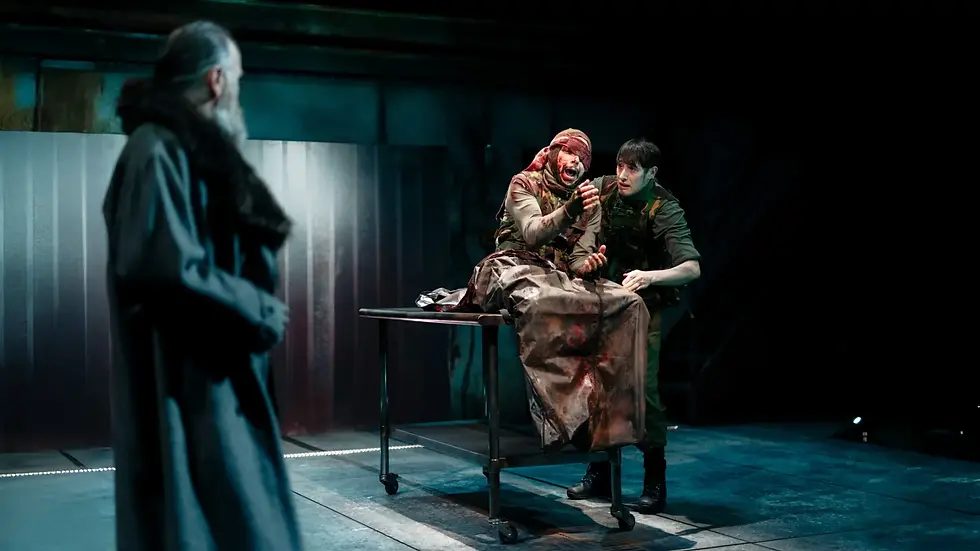
Visually, this is an undeniably striking production. Rachael Canning’s set design does a huge amount of heavy lifting, presenting a battered, two-tiered bunker that is decayed and oppressive. It’s the kind of space that immediately tells a story before a word is spoken. Paired with Annie May Fletcher’s atmospheric sound design and Sally Ferguson’s sharply detailed lighting, the production creates moments of real theatrical punch. Shadows stretch to make Macbeth look powerful, sound cues land with impact, and flashes of light punctuate moments of violence and the fulfilment of prophecies. When it works, it’s immersive and genuinely exciting.
And yet the production struggles to decide what it actually is. The opening, with the three weird sisters, leans into something psychological and unsettling. Then the soldiers arrive in full uniform, grounding us in a militarised reality. Then, without warning, characters appear in clean modern clothing, as if from an entirely different production. The result is a tonal patchwork that never quite settles. It’s not that any one of these ideas is inherently flawed; it’s that they don’t speak to each other. Instead of cohesion, we get contradiction.
This lack of clarity seeps into the storytelling. For a production that feels geared towards students encountering Macbeth for the first time, it is surprisingly difficult to follow. Secondary characters are difficult to identify quickly and clearly, key moments lose their definition, and the pacing in the first half, which stretches to 80 minutes, lacks urgency. Shakespeare’s text is already doing the work; it doesn’t need to be slowed down or over-emphasised. Yet here, dramatic pauses drain the scene, performances sometimes prioritise “acting” and not trusting the text, and the momentum repeatedly stalls. It becomes exhausting to watch, not because the material is dense, but because it is being held back.

Performance-wise, there is a clear divide within the cast. Some actors handle Shakespeare’s verse with clarity and confidence, while others rush or muddy it, creating an uneven quality across the production. This inconsistency makes it harder to stay engaged, particularly in a play where language is everything.
Oliver Alvin-Wilson’s Macbeth is a strong central performance. He brings intensity, emotional commitment, and clarity to the text. His delivery feels natural and accessible, allowing the audience to follow Macbeth’s psychological descent even when the production around him becomes unclear. There are moments where specific choices don’t quite land (like his patronising and sarcastic response to Lady Macbeth at the end of Act 1), but his presence anchors the piece.
Jo Mousley’s Lady Macbeth is more divisive. There is no denying her stage presence; she commands attention and brings psychological depth to the role. But her performance often tips into over-emotional, with frequent pauses that sap the energy from the verse. The result is a character that feels heightened from the outset, leaving little room to build. When the truly seismic moments arrive, there’s nowhere left to go. That said, her sleepwalking scene is a standout, focused, intense, and genuinely compelling.
From the supporting cast, there are some welcome highlights. Colin Hurley delivers a strong King Duncan and an entertaining Porter, demonstrating impressive range. Simon Trinder’s Macduff is understated but honest, cutting through the noise with a grounded performance. And Daniel Poyser's Banquo is well realised.
Not all elements fare so well. The three sisters, despite their visually intriguing, almost steampunk aesthetic, lack any real authority or presence. They feel like figures of style rather than agents of fate, which significantly weakens the play’s central tension. If we don’t believe in the prophecy, we don’t believe in Macbeth’s actions. I just couldn’t buy into why Macbeth would listen to these unauthoritative people who seemingly had no place, purpose, or power in the world on the stage.
There are also practical frustrations. Josie Morley and Deborah Pugh were almost entirely inaudible, with no apparent amplification support and what felt like no attempt to project their voices. In a theatre setting, that’s not just a minor issue. The entire scene between the Morleys’ nurse and Pugh’s secretary was unintelligible, which didn’t just slow the momentum but brought it to a halt.
Another highly significant problem lies in the relationship between Macbeth and Lady Macbeth. For me, there was little sense of connection or shared ambition between them. From the outset, their dynamic feels strained and out of sync, making it difficult to invest in their journey. The only notion that these two are a couple comes from an overlong, awkward snog on the balcony that attempts to establish intimacy but feels forced. Therefore, it is hard to understand why Lady Macbeth is so traumatised by her husband’s actions, and when it comes to the breakdown of their partnership, it doesn’t feel natural, so much as doing it for the sake of the script.
Then there’s the question of motivation. In a world that looks so broken, so devoid of structure or reward, what exactly is Macbeth fighting for? The production tells us he is driven by ambition, but ambition for what? The destroyed and barren kingdom he seeks to rule doesn’t appear worth having. The disconnect between text and visual world becomes impossible to ignore.
That said, when the production leans into its theatricality, it can be genuinely thrilling. The stylised battle sequences, particularly the final confrontation between Macbeth and Macduff, are dynamic and engaging. Fight director Haruka Kuroda brings a lot of energy to these moments.
This Macbeth is full of ideas. Some exciting, some frustrating. But they never quite align into a clear vision. It’s a production that reaches for something bold but doesn’t follow through. The ingredients are strong: an impressive design, committed performances, and a willingness to experiment. But without cohesion, clarity, or a unified voice, those ingredients never quite come together.
There’s no denying the ambition on display here, and there are flashes of brilliance that hint at what this production could have been. But theatre thrives on clarity of storytelling, and without it, even Shakespeare’s most powerful tragedy can lose its bite. This Macbeth may look the part, but it never quite seizes the crown.


Comments