
Inter Alia - Wyndham's Theatre Review

Updated: Apr 17
★★★★★
After the seismic success of Prima Facie. Suzie Miller’s new play, Inter Alia, at Wyndham’s Theatre, sets expectations sky-high. Led by a ferociously committed Rosamund Pike, the production promises another sharp dive into questions of consent, power, and responsibility. But is this simply a return to familiar territory, or does Inter Alia offer a bold new perspective through the eyes of a mother caught on both sides of the law?
Watch the Video Review:
Jessica Parks is a judge presiding over sexual assault cases with clinical precision and authority. At home, however, she is a mother navigating the complexities of raising an 18-year-old son, Harry. When her professional world and personal life collide, the play shifts from courtroom drama into something far more unsettling. The narrative isn’t driven by shock twists but by a slow, inevitable realisation of the legal system’s blind spots, particularly when those judging it are forced to confront it through their own lives.
What Inter Alia does so brilliantly is make the audience complicit. You are constantly being asked: What do you believe? Where do your sympathies lie? And would you do the same if this were your child?
That discomfort is largely driven by Pike’s performance, which is nothing short of extraordinary. She moves seamlessly between judge, mother, colleague, and wife, each version of Parks subtly shifting in social performance, tone, and energy. It’s a masterclass in the idea that we are all performers in our daily lives. It’s the kind of performance that feels exhausting to watch, not because it falters, but because of how relentlessly it demands your attention. Pike elevates the material beyond its limits; she makes this production entertaining and watchable, even though it could quite easily have become a lecture.
The first half of the play does lean into familiar territory. There are moments where the play’s core argument abandons the drama, where characters speak in ideas rather than impulses. At times, the play can feel less like a story unfolding and more like a case being presented. But here’s the thing: the subject matter almost demands it. This is not a subtle play, nor does it want to be. It signposts, it pushes, it challenges, and while that occasionally tips into heavy-handedness, it also ensures that its message lands with clarity and force. In a story about consent and accountability, there isn’t room for ambiguity.
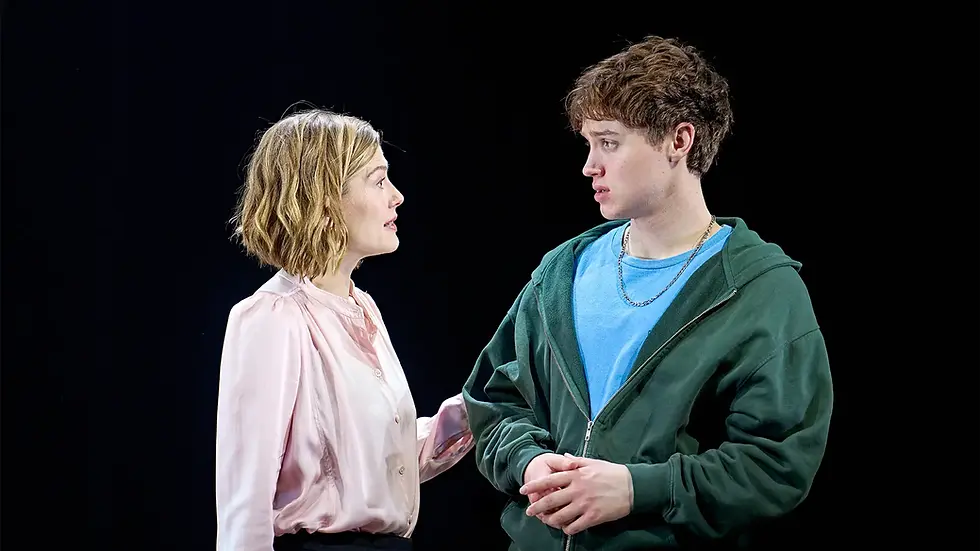
The supporting performances add further texture, even if the script doesn’t always give them the depth they deserve. Cormac McAlinden’s Harry is particularly compelling, a young man caught between vulnerability and accountability. He brings a softness to the role that makes the character feel frustratingly human. You don’t want to sympathise, but you understand him. That’s the play’s most dangerous trick. Jamie Glover, meanwhile, delivers a quietly devastating moment as Michael, articulating the generational confusion around masculinity and consent. It is a powerful message, delivered exceptionally by Glover, about how and why men struggle to talk to their children about these topics. It’s a fleeting scene, but one that packs an almighty punch.
If there’s a frustration, it lies in how some characters function more as symbols than people. Pike does her best to embody the offstage voices of clerks and colleagues, but they never quite escape their narrative function. Similarly, certain ideas, particularly around modern parenting, are hammered home with a bluntness that risks alienating some audience members. Not everyone will see themselves reflected here, and for those audiences, the emotional connection may be harder to access. There are also moments that feel slightly out of step with the rest of the play. References to online “manosphere” culture, for example, feel oddly shoehorned in, more topical than truthful.
Visually, however, the production is stunning. Miriam Buether’s set design is transformative. Spaces shift and evolve with cinematic fluidity: from a busy traditional office to a futuristic rock-concert courtroom, then into a naturalistic open-plan home, then into a dilapidated, worn-out children’s playground, before becoming disjointed and broken, mirroring Judge Parks's psychological unravelling. The staging is dynamic, bold, and constantly surprising.

And just when you think you understand the play, the final 40 minutes hit… Hard.
This is where Inter Alia finds its true voice. The earlier heaviness gives way to something raw, urgent, and deeply affecting. The play stops explaining and starts asking. It trusts the audience. And in doing so, it becomes something far more powerful than a legal drama; it becomes a shared emotional experience. You leave the theatre changed. Not in a neat, tied-up way, but in a messy, questioning, uncomfortable way. It lingers. It sparks conversation over dinner. It demands reflection on the tube ride home. And that is why this play is a success.
Inter Alia is not an easy watch. Nor should it be. It is provocative, unsettling, and fiercely intelligent. And thanks to a career-defining performance from Rosamund Pike, it becomes something essential. This is theatre that challenges, provokes, and refuses to let you sit comfortably in your seat, or your own beliefs. Sometimes, the most powerful verdict isn’t delivered in the courtroom, but in the silence that follows the curtain call.


Comments