
Avenue Q - West End Revival Review

Updated: Sep 18
★★★☆☆
Twenty years after it first shocked and charmed its way into musical theatre history, Avenue Q returns to the West End with a glossy new revival packed with updates, tech, and tweaks. For me, this was the first musical I ever saw; it was my formative gateway drug. But in a theatre landscape now bursting with innovation, does this anniversary production still feel essential, or is it simply trading on nostalgia with a few modern bells and whistles?
Watch The Video Review:
Set on a run-down New York street, Avenue Q follows Princeton, a recent English graduate trying to find his purpose in life. Along the way, he meets an eclectic mix of humans and puppets navigating adulthood, relationships, identity, and internet-era anxieties. Blending parody with sincerity, the show tackles big themes of racism, sexuality, and ambition through a deceptively playful, puppet-filled lens.
This revival isn’t a replica production; it's a reimagined Avenue Q for 2026. Anna Louizos’ set is the production’s most striking success, a clever evolution of the familiar crumbling street into a dynamic, unfolding world. What begins as a dingy façade transforms seamlessly into a music venue and even a wedding reception space, expanding the show's visual language without losing its original grit. It’s a thoughtful, ambitious design that genuinely enhances the storytelling.
Jean Chan’s costumes follow suit, embracing boldness with flair. Christmas Eve’s wedding dress is impressive, equal parts stunning and garish, perfectly capturing the character’s extravagance. Meanwhile, Nina Dunn’s video design integrates smoothly into the set, retaining the original show’s animated charm while layering in new digital textures. The addition of screens during “Life outside your apartment” and “Schadenfreude” feels purposeful rather than gimmicky.
Charlie McCullagh delivers a masterclass in puppetry as Nicky, Trekkie Monster, and the Blue Bad Idea Bear. Each character is vocally and physically distinct, but more importantly, each puppet feels alive! There’s breath, intention, and a constant sense of inner life, exactly what puppetry demands. It’s the gold standard which this production doesn’t always meet elsewhere.
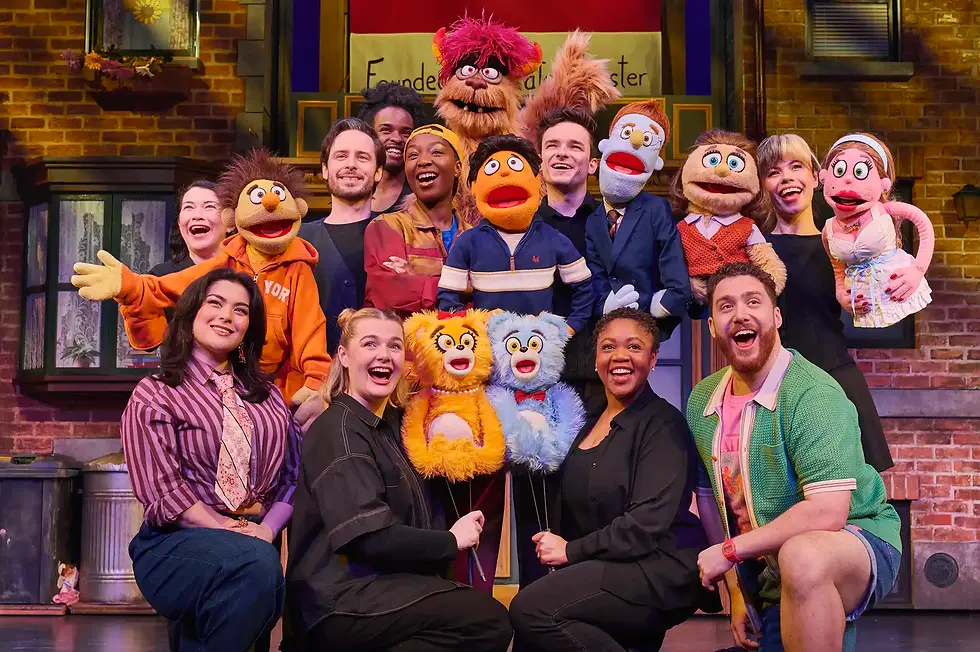
Amelia Kinu Muus is another undeniable highlight. Her Christmas Eve is vocally stunning, with “The More You Ruv Someone” emerging as the show’s musical peak. She sidesteps stereotype with ease, finding humour that feels character-driven rather than imposed. It’s a performance full of command and genuine charm.
Dionne Ward-Anderson brings a playful, irreverent energy to Gary Coleman while showing great respect for the late actor. Yet even here, the cracks begin to show. The decision to over-explain who Gary Coleman is, both in “It Sucks To Be Me” and the New Guy character calling him “That washed up child-celebrity”, feels massively patronising. Either trust the audience or change the reference entirely; sitting in between achieves nothing.
Unfortunately, for all its visual ambition and occasional brilliance, this production stumbles where it matters most: the puppetry. Too often, the illusion breaks. Puppets are left stranded on stage without performers, making them lifeless objects rather than characters. Dead puppets on stage aren’t just a visual issue; it’s a fundamental failure. Without life, without purpose, the entire conceit of Avenue Q begins to unravel. Frequently, puppets are upstaged, offering nothing but the back of their heads during dialogue. And perhaps most damagingly, some performers seem to forget the fundamental rule of puppet theatre: the puppet is the star! When actors overperform, drawing focus with exaggerated expressions that the puppet does not mirror, the magic collapses.
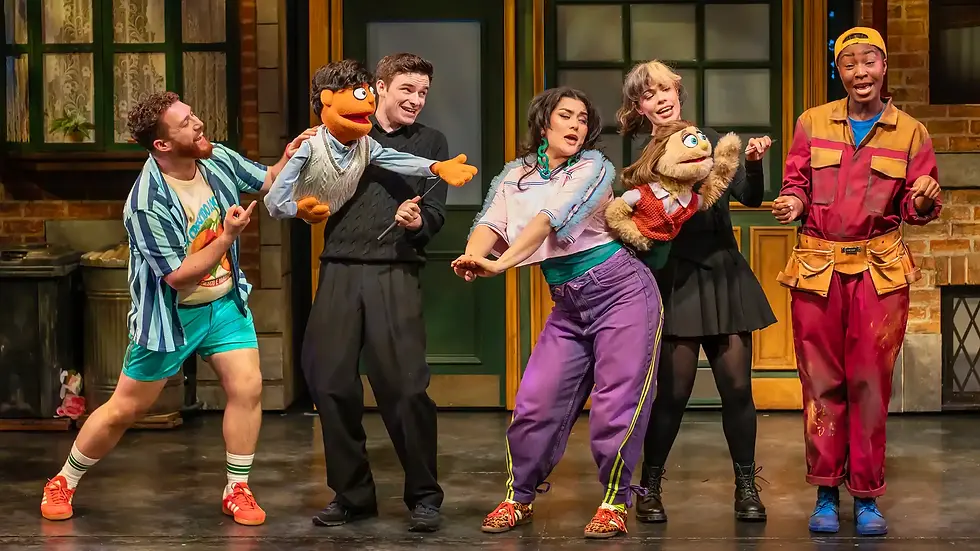
This is particularly evident in Noah Harrison’s otherwise impressive turn as Princeton and Rod. Vocally, he’s strong. His stage presence is undeniable. But Princeton lacks a consistent identity, wavering between two voices: an authentic interpretation and an approximation of the original cast recording. Rod, by contrast, is more fully realised, if slightly squeaky in tone. Yet Harrison’s biggest misstep comes in “Fantasies Come True.” What should be the show’s emotional heart is undercut by a baffling choice to have Rod pop bubbles during the climax. Bursting not just the bubbles but the emotional tension itself. It’s a moment that should land like a gut punch and instead drifts away, weightless.
The script itself remains both the show’s greatest strength and its most complicated challenge. Much of the original material still lands beautifully. Songs like “I Wish I Could Go Back to College” and “For Now” feel timeless, resonating just as strongly as ever. The structure is tight, the emotional beats are well-earned, and the humour, when left untouched, still lands wickedly. Plus, it’s the original jokes that garner the biggest laughs!
But the updates are a mixed bag. References to social media, OnlyFans, AI, and Spotify generally work, offering accessible entry points for new audiences. The song “Mixtape” becomes a scroll through a Spotify playlist, and whilst the new line "check out the rest" instead of "did you get to side-B yet?" does clang, it’s a modernisation that works. That said, modernising everything but having Kate Monster deliver a hand-written note instead of sending a text should be addressed.
Some of the changes stick out awkwardly, modernisation for its own sake rather than for clarity or comedy. For example, in “Everyone’s A Little Bit Racist”, Gary Coleman no longer tells “Polack” jokes; he now tells “White people” jokes, a change that feels pointless and unnecessary.

More concerning are the elements that haven’t been updated. There are elements that arguably need reconsideration that remain untouched. Whilst not offensive or antisemitic, certain Jewish references (“The Jews have all the money” and “Guys, Jesus was Jewish”) create an uncomfortable tension in the audience. It’s not about erasing the show’s edge, but about knowing what a modern audience is happy to laugh at, and understanding which edges still serve a purpose.
And that word purpose feels central here.
Because while this Avenue Q revival is undeniably good, it rarely pushes beyond that. The energy in the room feels oddly subdued, the performances occasionally undercooked, and the overall experience, despite its high points, never quite ignites. In a West End ecosystem currently brimming with exceptional theatre, “good” isn’t always enough.
There are flashes of brilliance. There are moments of genuine joy. There are elements of nostalgia. But they’re surrounded by inconsistencies that prevent the show from reaching its full potential. For those who’ve waited years to see it return, “Fantasies Come True.” But without the clarity, consistency, and craft to fully support its ambition, this Avenue feels like it’s still searching for its purpose.


Comments