
Gentleman Jack - Nottingham Theatre Royal, Review

Updated: May 16
★★★★☆
Northern Ballet’s Gentleman Jack at Nottingham’s Theatre Royal is a new ballet about Anne Lister, the Halifax landowner described as the first modern lesbian. This is a production full of heat, where queer female desire takes centre stage without apology or explanation. The real question is whether the production can match the boldness of its subject.
Watch the Video Review:
Gentleman Jack traces Anne Lister’s life, navigating a male-dominated society determined to make women smaller than they are. Fiercely intelligent and financially astute, Anne refuses to conform to the norms of femininity. She pursues relationships with women, most significantly with the married Mariana Belcombe, and later with the wealthy heiress Ann Walker, while also fighting for authority over her estate by confronting the men who would rather see her fail. Her diaries, in which she documented both her business dealings and her love life, sit at the centre of the production.
What makes this ballet so interesting is that it puts Anne’s love life at the forefront of the narrative. The most famous ballets are obsessed with heterosexual passion; here, the emotional and dramatic engine is two women across a dining table. Better still, it never congratulates itself or brags about how progressive it is. It gets on with the story! No trigger warning, no sign-posting about same-sex love, it is just allowed to happen, as it should be.
The romantic duets are the production’s strongest work, particularly Anne and Mariana’s dining-table dance, which is an undeniably intense and sexual piece of choreography. Lopez Ochoa understands that sexual tension should build, like Anne hovering a servant’s bell over Mariana’s body, tracing it down her spine without touching her. There are no awkward body contortions or obvious tableaus trying to scream passion at the audience. Instead, the movement is suggestive but firm. The dining table itself becomes a brilliant recurring symbol: men stand on it to assert their dominance, but Anne and her lovers reclaim it as a site of intimacy. Furniture becoming foreplay… Now that’s theatre!
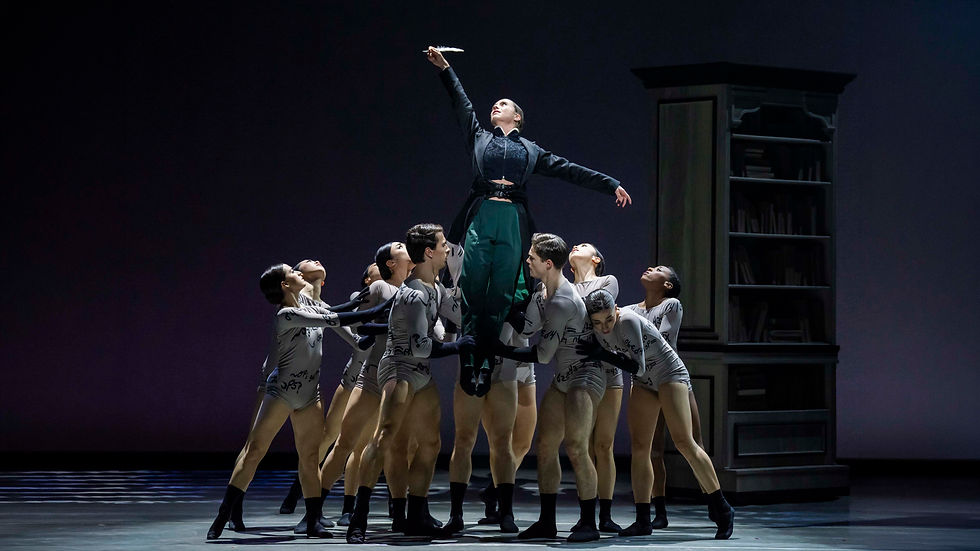
Lopez Ochoa’s choreography throughout is crisp and refreshingly specific. It works through tension, stillness, repeated motifs, and the kind of ensemble storytelling that speaks from the body rather than in obvious mime or grandiose lifts. Anne’s flick of the hat, the rap of her cane against the floor, the way men move around her, these details build character far more effectively than explanatory gestures ever could.
That said, there are moments when the choreography feels too focused on beauty and not focused enough on conflict. When Anne confronts Christopher Rawson, the scenes are visually elegant, full of turns, kicks, and carefully composed lifts, but the men never feel like they’re dominating Anne, or that she is struggling to match their power. This should feel dangerous, even humiliating. Instead, it often feels decorative. In this instance, I’d rather see ugly and honest than pretty for the art. However, the closing scene of Act 1, in which Anne is physically overthrown by men, was perfectly pitched.
Peter Salem’s score sits in a similar space. It is evocative and intelligent, and it supports the story, but it occasionally feels too safe. The compositions carry a cinematic quality that works in establishing atmosphere and period, but I wanted the music to take more risks. There were moments when the score could have breathed more, become smaller, or become more invasive. During Anne’s heartbreak when Mariana chooses marriage and social safety over love, the music felt more like a cinematic funeral lament. The heartbreak is there intellectually, but for a production so alive in its erotic tension, some of the emotional collapse feels oddly polite.

Christopher Ash’s moving screens and bookcases are a stroke of genius, allowing landscape, cityscape, and private interiors to slide in and out of view without the clunkiness of a full set change.
Louise Flanagan’s costumes are equally sharp. Anne’s masculine tailoring, her top hat, and black coat immediately establish her refusal to conform. Anne’s diaries are brought to life with ensemble figures that appear in costumes covered with her writing, turning her private thoughts into a public presence. There was also a practical aspect to the costumes, with removable skirts and sleeves allowing intimacy scenes to have a physical undressing rather than being constrained by modesty.
The dancers are exceptional. Nida Aydinoğlu gives Anne Lister extraordinary command, full of swagger and erotic authority. The evening’s stage belonged to Aydinoğlu with such a forceful and intelligent interpretation of this historical figure. Sarah Chun brings tremendous emotional precision to Mariana, especially in moments of jealousy and retreat; she understands that sensuality depends on mutual tension, not simply Anne dominating the room. Julie Nunès’s Ann Walker delivered nervous delight and humour, particularly in the scene where Anne courts her in front of her parents.
Gentleman Jack is a ballet that places queer female desire at the centre of classical storytelling and trusts it to carry the evening. It is stylish, sexy, and theatrically confident, with enough intelligence behind its sensuality to linger long after the curtain call. Northern Ballet have given Anne Lister exactly what she would probably have demanded… The last word. This Jack certainly knows how to play her cards right.


Comments