
Small Island - Nottingham Playhouse Review

★★★★☆
Small Island at Nottingham Playhouse is an emotionally charged revival that grapples head-on with Britain’s Windrush legacy, leaving me frustrated, cold, and quietly ashamed. Directed by Matthew Xia and adapted by Helen Edmundson from Andrea Levy’s novel, it is unapologetically ambitious in both scale and intent, but does that ambition always serve the storytelling?

The narrative interweaves the lives of characters across Jamaica and post-war Britain. It follows Hortense, a Jamaican woman who travels to England after the war expecting a prosperous new life, only to find hardship and disappointment, and Gilbert, a former RAF serviceman who returns to Britain determined to build a future despite the prejudice he faces. Their lives intersect with Queenie, a kind-hearted but naïve Brit who rents rooms in her home to Jamaican lodgers while her husband, Bernard, is away at war. As Bernard returns and tensions rise within the household, the four lives become increasingly entangled, leading to difficult choices that ultimately reshape their relationships and futures.
What’s immediately clear is the conviction behind the production. This is not a company going through the motions; it is a group of artists who believe in what they are saying. The ensemble operates as a unified storytelling force, shifting between roles, accents, and environments with precision.
Edmundson’s script is rich and detailed, capturing a breadth of experience that feels historically and emotionally authentic. It has a 3-hour-and-15-minute runtime and is densely packed. Characters appear, disappear, and re-emerge, sometimes asking the audience to hold onto details for long stretches before being rewarded. If you’re willing to give it your undivided attention, this show will blow you away. If you’re uninvested, you’ll flag.
The depiction of racism is unflinching. Gasps ripple through the auditorium at the use of racial slurs, not out of shock at their existence, but at the rawness of their delivery. These scenes are not artistic abstractions; they are lived experiences. These moments aren’t here as a lecture; they're the brutal truth of the times, and presenting them this way ensures they land with devastating clarity.

Anna Crichlow’s Hortense is nothing short of phenomenal. She charts the character’s journey with extraordinary precision, from youthful optimism to hardened resilience. What’s remarkable is her restraint; so much of Hortense’s story is told through stillness. With a clenched jaw and a distant stare, Crichlow allows silence to speak volumes.
Bronté Barbé brings warmth and complexity to Queenie. This character often says the wrong thing, but through Barbé’s charm and innocence, we understand the good-hearted intention behind it. She becomes a character caught between ignorance and empathy, and that tension makes her endlessly watchable.
Daniel Ward’s Gilbert is a revelation. Effortlessly funny, disarmingly charming, and then, when the script demands, utterly hollowed out by experience. His shift from lightness to something far more broken is one of the most compelling arcs on the stage. It’s a performance that understands timing, tone, and emotional depth in equal measure.
Mark Arends as Bernard is gentle and slightly awkward, someone the audience instinctively roots for. But when the character pivots sharply into racism in Act 2, the groundwork doesn’t fully support the shift. The transformation feels abrupt rather than inevitable, leaving the audience scrambling to understand why this previously lovable character is now the villain.
Elsewhere, Marcia Mantack and Everal A Walsh deliver standout comic turns as Miss Jewel and Kenneth, injecting energy and humour into the production. Yet both characters feel underutilised.
Visually, Xia’s direction is assured and exhilarating. The staging is kinetic and fluid, relying on movement and choreography to transition between locations. Scenes flow into one another with cinematic speed, creating a sense of constant motion that mirrors the narrative’s geographical and temporal shifts. It’s inventive, cohesive, and impressive.
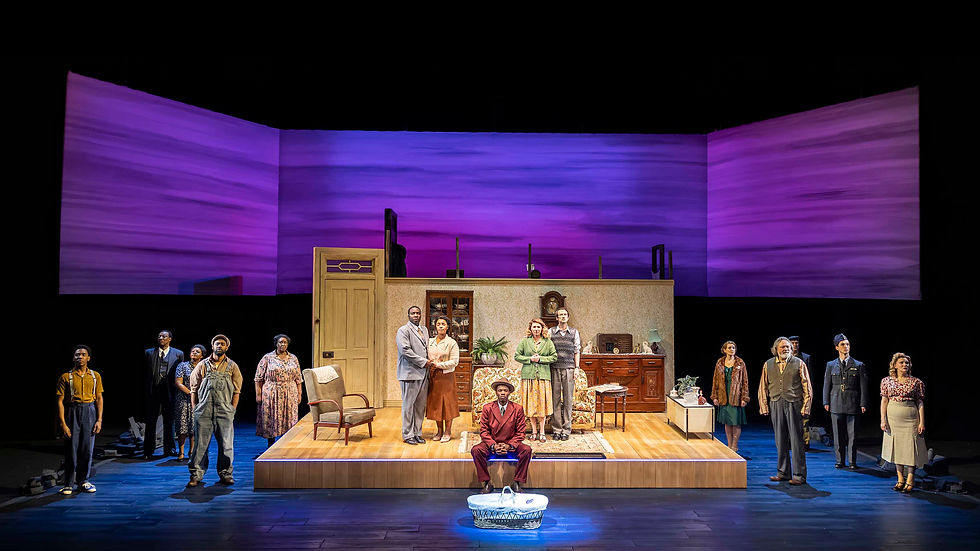
For me, not every choice lands. The video projections, while well-researched by designer Gino Ricardo Green, ultimately feel unnecessary. Their repeated appearances begin to disrupt the momentum rather than enhance the storytelling, particularly towards the end of Act 1, where their rapid succession feels like a relentless, artificial extension rather than a meaningful addition.
Similarly, some of Adrienne Quartly’s sound design choices are distracting. Generally, the atmospheric sounds sit in the background, adding detail to the world of the play, but at times they pull focus from the actors. One moment, the sound of what appeared to be glass being swept becomes so intrusive that it broke my concentration, pulling my attention away from a pretty important scene.
Structurally, I think this play would benefit from a three-act structure, breaking at the emotional peak of the cinema scene in Act 1 and again after the birth in Act 2, allowing the story to breathe and land its major beats with greater impact. The current interval feels dictated by staging logistics rather than narrative necessity.
However, none of these flaws matters, because this is such an interesting and enlightening story that you will become absolutely engrossed in it. It asks a lot, over three hours of dense, layered storytelling, but it rewards that investment. Small Island at Nottingham Playhouse is fearless. It is a production that understands the importance of its story and commits to telling it with honesty. You may, like me, leave feeling uncomfortable, but that’s exactly the point. After all, this is one island whose impact stretches far beyond its shores.


Comments