
The Unlikely Pilgrimage of Harold Fry - Theatre Royal Haymarket Review

Updated: Apr 17
★★★☆☆
There’s something about The Unlikely Pilgrimage of Harold Fry that feels out of step with the rest of the West End. With so many spectacle-driven musicals, this piece leans into stillness and storytelling; a folk tale told through gentle melodies and reflective moments. It’s a show that serves more sincerity than swagger, asking its audience to lean in rather than sit back. But when folk storytelling is placed on a stage built for scale, does it lose some of that charm in the process?
Watch The Video Review:
The story is beautifully simple. Harold Fry, an ordinary, emotionally reserved man, receives a letter from an old friend, Queenie, who is dying of cancer. On impulse, he sets out to walk the length of the country to see her, convinced that his journey will somehow keep her alive. Along the way, he encounters strangers who offer fragments of wisdom, humour, and perspective, forcing him to confront his past, his marriage, and the regrets he has long buried. It is a story about grief, redemption, and the quiet, transformative power of human connection.
There is no denying that this is a heartfelt piece of theatre. It resonates in an unmistakably subconscious way, the kind that catches in the back of your throat rather than hitting you over the head. This is not a show that tries to manipulate its audience into emotion; instead, it trusts the story to do the work. When it lands, it’s genuinely affecting.
Much of that success rests on the shoulders of Mark Addy, who is remarkable as Harold. There’s nothing showy about him at all, just a deeply human performance that makes Harold instantly recognisable. Addy is the emotional anchor of the production, guiding us through the journey with a sense of authenticity that never wavers. It’s such an honest and real interpretation of the character without being an acting exhibition, and this gives the show its beating heart.
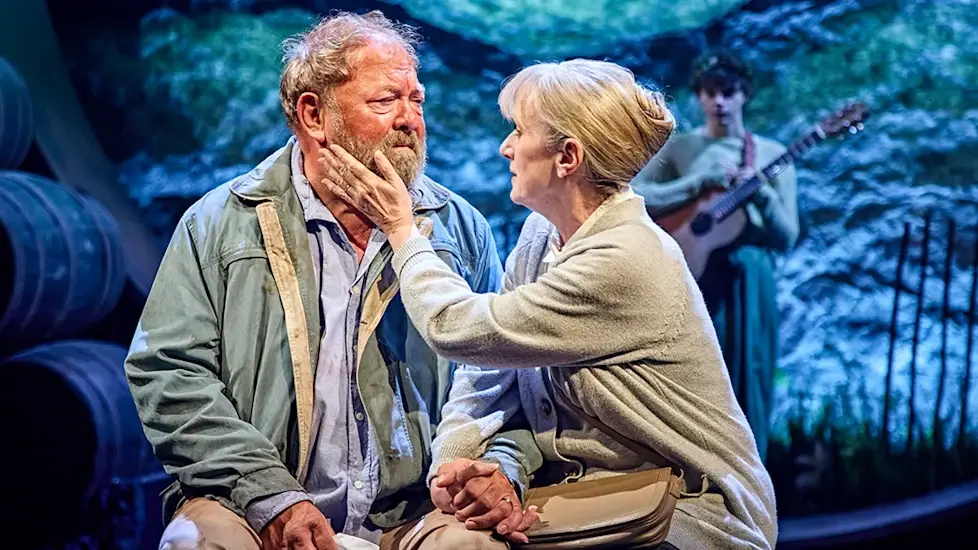
Jenna Russell offers equally compelling work as Maureen, Harold’s wife. While her musical numbers may not leave a lasting impression, her dramatic performance is exceptional. She brings a layered emotional complexity to Maureen, balancing dry wit with deep-seated pain, and her scenes provide some of the production’s most powerful moments. There’s a richness to her performance that highlights the play lurking beneath the musical, and honestly, I think I may have enjoyed a straight drama interpretation more.
Nicole Nyarambi’s Garage Girl provides a welcome spark early on, injecting energy and urgency into the narrative just when it needs it. Nyatambi is vocally impressive and genuinely engaging. Her performance of “Walk Upon The Water” is sensational and the closest the show comes to a traditional musical.
Passenger’s score is, in many ways, the show’s strength and its limitation. Its folk-inspired sound is beautifully aligned with the storytelling, creating a cohesive and consistent atmosphere throughout. There are some warm, lovely songs, sincere, quiet numbers, and even a handful of genuinely funny comedy tracks (including an unexpected song involving a sugar daddy wanting to lick his lover's shoes for gratification). But across two acts, the musical palette feels limited. Without a standout showstopper or any memorable hook, the songs tend to blur together, supporting the narrative rather than elevating it. It’s pleasant, but rarely thrilling.

Structurally, the show struggles most in its first act. The journey format, Harold meets a character, they share a story through song, and then disappear, quickly becomes predictable. It’s storytelling by repetition, following a familiar rhythm that, while appropriate, begins to feel mechanical. Each encounter offers insight, but none of these ensemble characters lingers long enough to leave a lasting impact or ever meaningfully return. As a result, the supporting characters feel underdeveloped, more like narrative devices than fully realised people.
Act Two, however, finds greater clarity and purpose. The episodic structure gives way to a more focused narrative, and the emotional stakes begin to deepen. Interestingly, as the songs recede slightly, the storytelling becomes stronger. There’s a fluidity here that was missing earlier, and it allows the piece to finally breathe. In these moments, the show feels confident in what it is, and it’s all the better for it.
That said, there are times when the writing leans a little too heavily into its message. Certain lyrics and narrative beats feel a little on the nose, spelling out emotions that might have resonated more powerfully if left unsaid. It’s not enough to undermine the piece, but it does occasionally flatten its potential emotional impact. Folk storytelling often embraces clarity, but theatre thrives on ‘show, don’t tell’; so these narrative devices are at loggerheads.

The production’s biggest challenge, without a doubt, is its scale. This is an intimate story, one that thrives on closeness, nuance, and quiet reflection. On a large West End stage, that intimacy is harder to sustain. The design works hard to create a sense of community and cohesion, and it succeeds to a point. But there are moments where the stage feels too vast for the story it’s trying to tell, where the emotional detail gets lost in the space. It’s hard not to imagine how much more impactful this might feel in a smaller venue, where the audience could truly sit with the storyteller rather than observe them from a distance.
Unfortunately, not every character lands. The Balladeer, played by the understudy Timo Tatzber, feels like a missed opportunity. As the narrative guide, the character should draw us into the story, but instead, the songs often feel like underwhelming interruptions rather than a source of propulsion. The opening number, in particular, lacks pull, meaning the audience’s connection to the piece takes far too long. It’s a shaky start for a show that relies so heavily on an audience’s investment.
And yet, despite its flaws, there is something undeniably appealing about The Unlikely Pilgrimage of Harold Fry. It’s a show that values kindness, humanity, and quiet reflection, qualities that feel increasingly rare in the West End. It doesn’t always succeed in translating its intimate storytelling to a larger stage, and its structure and score occasionally limit its impact, but its heart is firmly in the right place.
This is a gentle, thoughtful piece of theatre that will resonate with audiences willing to meet it on its own terms. It may not be the most dynamic journey, and it may take a few wrong turns along the way, but there’s still something worthwhile in walking alongside Harold, even if the path isn’t always as compelling as it could be.


Comments