
Kiss of the Spider Woman - Curve Theatre, Review

Updated: Apr 17
★★★★★
Musicals can often feel too polished, reverent, or overly safe, but Kiss of the Spider Woman at Curve, Leicester, is anything but. This is a production that pulses with danger, intimacy, and raw human connection, driven by an extraordinary cast and creative team working in perfect sync. From the moment the lights snap into that claustrophobic prison cell, it grips you and refuses to let go. Walking into a studio theatre to see a musical I know very little about fills me with a mix of dread and anticipation, so, is Kiss of the Spider Woman any good?
Watch the Video Review:
Kiss of the Spider Woman is set in a prison; it follows Molina, a flamboyant and sensitive window dresser, and Valentin, a hardened political prisoner, forced to share a cell. To escape the harshness of their reality, Molina recounts elaborate stories about old Hollywood films, centring on the glamorous actress Aurora, who once played the dangerous character Spider Woman. As their relationship slowly evolves, fantasy and reality begin to blur, revealing deeper truths about love, identity, and sacrifice.
What makes this production so compelling is its absolute clarity of vision. The time, place, and oppressive atmosphere are so vividly realised that you settle into the world instantly. There is no confusion, no unnecessary clutter, just deliberate storytelling. Director Paul Foster ensures that nothing feels accidental. Every glance, every pause, every shift in tone feels earned.
The slow-burning relationship between Molina and Valentin is the beating heart of the piece, and it is handled with remarkable patience. In a world where pacing often feels dictated by an audience’s need for constant stimulation, this production dares to take its time, and it pays off beautifully. The emotional evolution is gradual, detailed, and utterly captivating. By the time the line between them begins to blur, you realise you’ve been watching something meticulously constructed from the very first moment.

And then there’s the cast… phenomenal doesn’t quite cover it.
Fabián Soto Pacheco’s Molina is, quite simply, the performance of the night. There is a danger with this role; it can so easily tip into caricature, but Pacheco avoids every cliché with astonishing control. His Molina is funny, yes, and occasionally flamboyant, but also deeply vulnerable, perceptive, and grounded. He understands exactly when to dial the performance up and when to strip it back, creating a character that feels achingly real. The audience doesn’t just watch Molina; they fall in love with him. It’s a performance of exquisite control.
Opposite him, George Blagden’s Valentin is equally compelling. Beginning as a closed-off, almost impenetrable figure, Blagden charts a careful and convincing transformation into something softer, more open, more human. It’s a difficult arc to pull off: too fast, and it feels false, too slow, and it risks being dull. Blagden pitches it perfectly. His vocal work is also exceptional, bringing a richness and intensity to the score that lands with real impact.
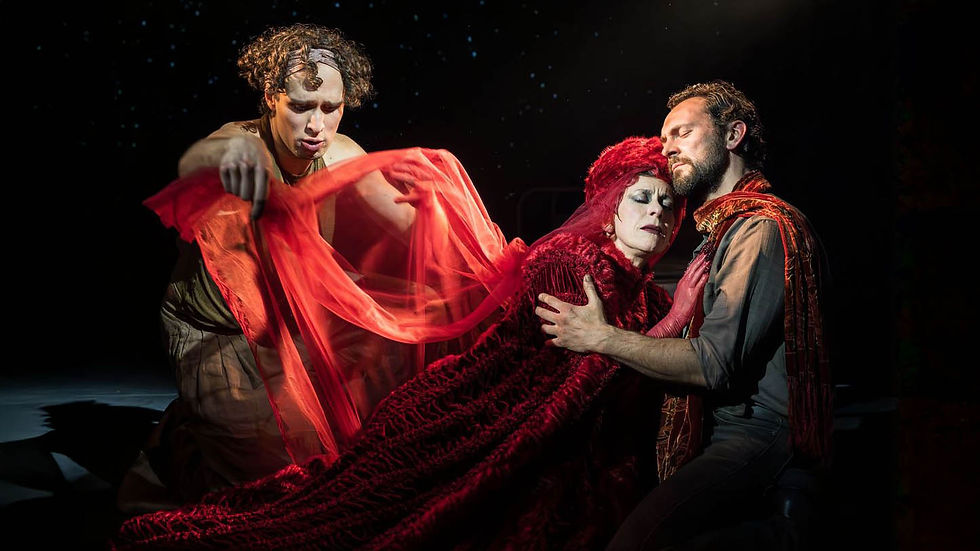
Anna-Jane Casey, as Aurora and the Spider Woman, is a force of nature. She glides onto the stage with the presence of a classic Hollywood icon, all elegance and poise, before twisting into something far darker and more unsettling. There is a genuine sense of menace in her Spider Woman, becoming both seductive and deeply unnerving. Vocally, she is sublime. Those rich, velvety tones wrap around the auditorium, commanding attention with effortless authority. Silk and steel in equal measure, Casey’s voice is gold dust.
The supporting cast deserves their flowers too. Tori Scott delivers a vocally stunning turn as Molina’s mother, particularly in the emotionally charged “You Could Never Shame Me.” Jay Rincon’s Warden is commanding, his voice carrying an authority that fills the space. Damian Buhagiar brings a physical commitment to his role that adds to the production’s visceral edge.

This is a very physical piece of theatre. The violence never feels stylised or safe; it feels immediate, dangerous, and, at times, genuinely uncomfortable to watch. Credit must go to fight director Kate Waters, whose work ensures that every moment of conflict lands with authenticity.
Visually, the production is a triumph of simplicity. David Woodhead’s set design uses minimal elements, a square on the floor, a suggestion of walls, yet, with Howard Hudson’s lighting, it becomes a fully realised prison cell. When the world expands beyond that space, it feels enormous by contrast. Andrzej Goulding’s video design adds another layer, transforming Aurora into a cinematic icon by projecting grainy film imagery on the large video backdrop.
Gabriella Slade’s costumes for Anna-Jane Casey are exceptionally striking. Aurora’s looks are dripping in old Hollywood glamour, plush and elegant, but always with a sparkle and the long fingernails that hint at something a little more dangerous.
Musically, the show delivers. Songs like “Dear One” swell with emotional power, while “Over The Wall” lives rent-free in your head during the car ride home. The score balances intimacy with theatricality, never overwhelming the story but always enhancing it.
If there are criticisms, they lie in the finer details. There are occasional staging moments where a flown-in set piece obscures action on the balcony. Similarly, a handful of sound design choices feel slightly mismatched, such as a door effect that doesn’t quite align spatially with what we see (hard panned right, but we see it happen centre stage!). But these are minor blemishes on an otherwise exceptional production. When the only real notes are this specific, you know something special is happening.
This is theatre that understands the power of intimacy. It doesn’t need spectacle to make an impact; it relies on the performers and the storytelling in the text. Kiss of the Spider Woman is a triumph! intelligent, affecting, and performed with breathtaking skill. It’s a production that lingers, that seeps into your bones, because once you get caught in its web, you’ll find it impossible to escape.


Comments