
Sherlock Holmes: The Hunt for Moriarty - Derby Theatre Review

Updated: May 8
★★★☆☆
Sherlock Holmes: The Hunt for Moriarty at Derby Theatre is a fast-paced, visually inventive Holmes adaptation that turns deduction into an exhibition, but does it sacrifice tension for explanation?
Watch the Video Review:
Nick Lane’s adaptation drops us into the aftermath of catastrophe: 221B Baker Street, charred and broken, Holmes presumed gone, and Watson left to piece together the events that led to the fall. From there, the play rewinds, assembling a dense conspiracy that pulls together elements from multiple Conan Doyle stories. It is packed with political intrigue, stolen documents, and international espionage, all pointing to the elusive figure of Professor Moriarty.
The Hunt for Moriarty is a theatrical puzzle box, with each scene offering a revelation and encouraging the audience to try and solve the mystery alongside Holmes. The constant clues and reshaping of what we already knew help to give this production momentum. This is a long evening, pushing close to three hours, yet it doesn’t feel indulgent. Scenes flow rapidly, and discoveries land neatly; it’s a mystery that refuses to sit still.

The play is undeniably dense. By stitching together multiple Holmes stories (including The Bruce-Partington Plans and A Scandal in Bohemia) into a single narrative, the script creates a world where everything matters all at once, and the stakes are high. There are moments where the mystery tips into explanation, where characters tell us what is important rather than allowing us to experience it, but anyone who has read Sherlock Holmes will know that’s very much the style.
Watson’s narration is the clearest example of this balancing act. Ben Owora delivers it with precision, never allowing it to feel like a burden. He doesn’t simply explain events; he colours them, guiding us through the chaos. Owora’s Watson is the bridge that connects the audience to the world onstage.
Victoria Spearing’s set is a fantastic storytelling device. Beginning with a fire-ravaged Baker Street is an inspired choice; it strips away the cosy nostalgia usually associated with Holmes and replaces it with something far more unstable. The space folds, doors reveal bodies, and locations transform rapidly, allowing scenes to bleed into one another without interruption.
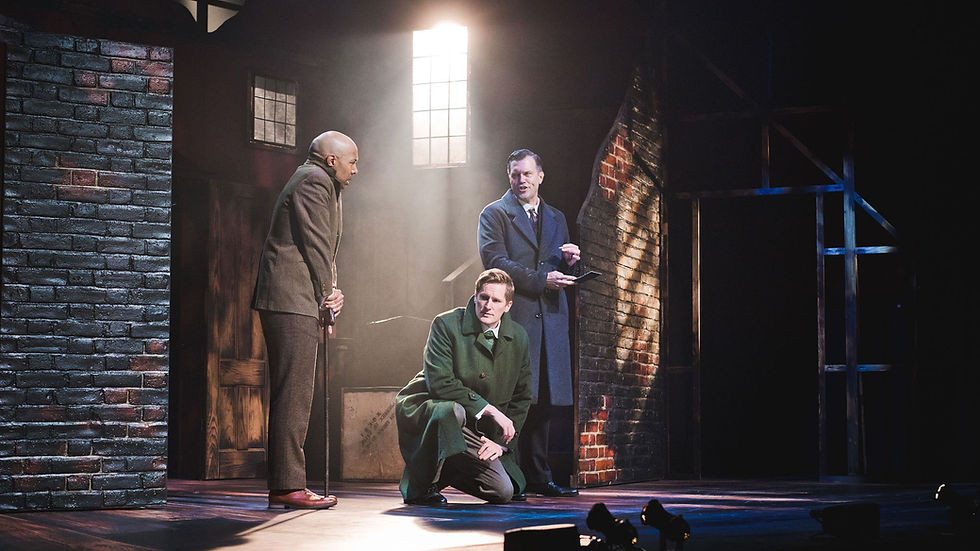
Mark Hooper’s projections elevate this further. Letters appear and dissolve across the walls, maps guide us through the plot's geography, and key moments are punctuated with projected sketches that give exposition a physical presence. It’s a smart solution for a text-heavy script: if the audience must process information, at least they have something dynamic to look at while doing so.
Gavin Molloy gives a controlled performance as Moriarty; he is calm, measured, and genuinely unsettling without slipping into villainous stereotypes. But he is massively underused. For the majority of the play, he exists as a looming off-stage presence, a faceless threat. However, after hours of build-up, the confrontation feels brief; it is one of the few moments where the play reaches something deeper than puzzle-solving, and it passes far too quickly. For me, there would have been more power in keeping this character off-stage or bringing him on far sooner. Personally, I wanted more Moriarty!
Mark Knightley’s Holmes avoids imitation, instead grounding the character in a restless, analytical physicality. There’s a sharpness to his performance, a sense of a mind constantly racing ahead of the room. His interpretation leans into a kind of neurodivergent energy, not as a label but as a lived experience: Holmes sees differently, processes differently, and that difference drives both his brilliance and his detachment.

The ensemble for this production picks up the remaining characters exceptionally well. Pippa Caddick’s multi-rolling is particularly sharp, shifting between accents, posture, and social status. Her movement between Cockney, Yorkshire, RP, and American is flawless. Robbie Capaldi and Eliot Giuralarocca also provide solid support across a vast range of roles. The production depends on the audience understanding who is who at all times, and remarkably, given the long register of characters, it never becomes confusing.
There is something to be admired about a production performing unamplified; it is a choice that aligns with the production’s commitment to a more traditional theatrical style. But in practice, the acoustics of Derby Theatre didn’t support it. There are moments where dialogue loses clarity, and in a plot this intricate, missing even a single line can disrupt comprehension. This is not an issue of performance but of audibility; would microphone support have helped me to engage with the story more? I think it would.
Sherlock Holmes: The Hunt for Moriarty knows what it is offering and delivers it with confidence. This is a clever, fast-moving Holmes adventure that prioritises ingenuity over emotional depth. It may not always land its biggest ideas, but it rarely loses its audience. Sure, it over-explains itself, and it under-delivers on its titular villain, but it is also inventive and well-performed. For fans of Holmes, mysteries, and whodunnits, there is a great deal to enjoy here.


Comments