
Miss Saigon, Theatre Royal Nottingham - Review.

★★★☆☆
Miss Saigon arrives at the Nottingham Theatre Royal with all the hallmarks of a major revival: epic score, grand staging, and a cast ready to deliver powerhouse vocals night after night. Sitting in the auditorium, watching this production unfold, I couldn’t help but wonder: Does such an epic tale of war and love still work in a modern age, or does the lack of re-imagining leave you feeling uncomfortable rather than moved?

Set against the backdrop of the Vietnam War, Miss Saigon tells the story of Kim, a young Vietnamese woman forced to work as a prostitute aged 17. She falls in love with an American soldier named Chris. Their brief but intense relationship is torn apart by the fall of Saigon, leaving Kim to raise their son alone while Chris returns to America, believing her to be dead. Years later, Kim reaches out in the hope of rekindling their love and restarting her life in America. It is a story of love and loss on an operatic scale, underscored by one of musical theatre’s most beautiful scores.
There is no denying that Miss Saigon still has the power to impress. The music alone remains one of the greatest achievements in musical theatre. The orchestra, under the direction of Ben Mark Turner, delivers it with richness and precision, allowing the music to do much of the emotional heavy lifting. The swelling strings, the percussive punches, the sheer scale of the sound; it is undeniably thrilling. At times, the music feels like the true protagonist of the piece, guiding us through the narrative with more clarity than the staging or direction manages. That said, the conductor's visibility, passionately leading from the pit, became repeatedly distracting… a small but persistent pull away from the action on stage.
Visually, George Reeve’s projection design is a standout, particularly in the war sequences, where it adds a cinematic depth that enhances the storytelling. Bruno Poet’s lighting design is equally slick, supporting both the intimate and large-scale moments with clarity and control. Andrew Edwards’ set does its job effectively, though it rarely surprises, with the exception of sequences like Dreamland and Bangkok, where the show leans into spectacle and reminds you just how visually exciting Miss Saigon can be when it commits.
And yet, for all its technical accomplishment, this production struggles with a more fundamental question: why this version, now?

One of the most consistent criticisms of Miss Saigon over the years is its dated perspective, particularly in its portrayal of Vietnamese characters and its underlying “Look at how great America is” attitude. This production does little to challenge or reframe those elements. Instead, it presents the material largely as it has always been, which in 2026 feels like a missed opportunity. If you’re going to revive a show with such complex and controversial themes, there’s an expectation, or at least a hope, that it will engage with them critically. Here, it doesn’t.
There are sparks of genuine theatrical power; the flashback to Chris leaving Saigon without Kim is particularly striking, but they are undercut by melodramatic moments. Mikki Juan’s Thuy, in particular, feels overplayed, turning what should be emotionally charged encounters into something soap opera-esque rather than moving. This imbalance is evident from the very beginning. The opening scene, instead of immersing us in a sleazy, oppressive brothel where the girls are desperate to escape, is staged more like an energetic party. Without that sense of danger or entrapment, the stakes don’t feel high enough, and the audience is left observing rather than investing.
Vocally, the cast is undeniably strong. There is not a weak singer among them, and the technical standard is consistently high. However, the musical direction leans heavily into constant belting, turning almost every number into a wannabe power ballad. While impressive on a technical level, it becomes exhausting to listen to. Without variation, without moments of softness, without restraint or intimacy, the emotional impact of those big vocals is lost. When everything is loud, nothing feels powerful. Songs blur together, losing their individual identity in a sea of shouty high notes.
Julianne Pundan, as Kim, delivers a committed and vocally assured performance. Her voice soars with ease, hitting the demanding heights of the score with precision and control. She carries the show’s emotional core with consistency. However, Kim is a character who lives in the quiet moments as much as the big ones, and those quieter shades are sometimes lost here.
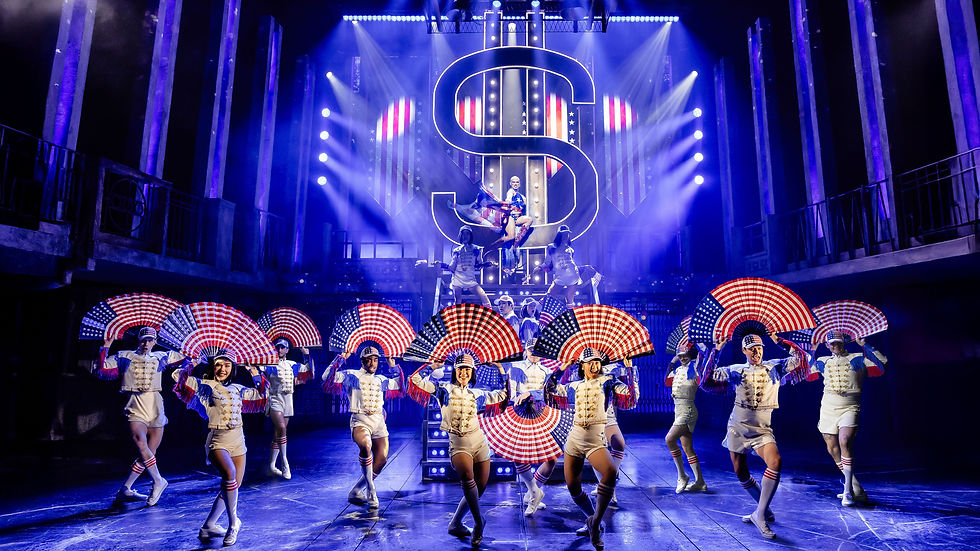
Seann Miley Moore is, without question, the standout of the evening as The Engineer. Bursting with charisma, energy, and a sense of playfulness, Moore brings a much-needed spark to the production. His performance is bold, flamboyant, and unapologetically theatrical, and while that may divide opinion, it provides a refreshing contrast to the show’s otherwise earnest tone. His rendition of “The American Dream” is electric, drawing the audience into his character’s warped, aspirational vision of America. It’s one of the few moments where the production feels fully alive.
Dominic Hartley-Harris brings a smooth, velvety quality to John. His presence, though supporting, is felt strongly, and he provides a welcome sense of control and clarity. Emily Langham’s Ellen delivers one of the evening’s most genuinely affecting moments with “Maybe.” In contrast to the show’s prevailing vocal style, this performance is intimate, restrained, and emotionally honest, a reminder of how powerful material can be when it’s allowed to breathe.
Understudy Daniel J Brian, stepping in as Chris, gives a thoughtful and emotionally accessible performance. There’s a vulnerability to his portrayal that makes you root for him, even when the narrative sidelines him for long stretches. It’s a shame the character disappears for much of the show, as Brian’s performance suggests there’s more to explore.
Perhaps it’s the score, perhaps it’s the scale, or perhaps it’s simply the story itself, but there is something undeniably compelling about Miss Saigon. This production will undoubtedly satisfy long-time fans of the musical, and there are moments of genuine brilliance scattered throughout. But for those hoping for a reimagined or recontextualised take, it may feel like a missed opportunity. It’s a production that showcases immense talent, yet struggles to justify its place in a modern theatrical landscape. If nothing else, it proves that while Miss Saigon remains a musical titan, it may be time to ask not just how we stage it… but why.


Comments