
PUBLIC: The Musical, Curve Leicester Review

★★★★☆
PUBLIC: The Musical at Leicester's Curve takes four strangers and locks them inside a gender-neutral public toilet. Following award-winning runs at VAULT Festival and Edinburgh Fringe, Hannah Sands and Kyla Stroud's pop-rock musical comes with plenty of buzz behind it. The question is whether this Fringe success can make the jump to a larger producing house without losing the intimacy that made it work in the first place.
Watch the Video Review:
When an automatic locking malfunction traps four very different people inside a public toilet, escape quickly becomes the least of their concerns. Laura is on the way to Paris to marry their fiancée. Andrew is a finance worker whose expensive bicycle has just been stolen. Finlay is desperately trying to get to work while worrying about his grandmother's medication. Zo is an outspoken activist determined to educate everyone around her. Forced into conversation, assumptions are challenged, secrets emerge, and personal frustrations bubble to the surface.
The biggest surprise is just how visually inventive the production is. Amy Jane Cook's set design transforms what sounds like the least theatrical location imaginable, a public toilet, into one of the evening's greatest strengths. The moving cubicles reshape the playing space, creating fresh stage pictures while keeping the set very claustrophobic, and UV-painted walls reveal an exciting moment during the song ‘Graffiti’. It is a set that understands precisely when realism needs to give way to theatricality.
Katy Morrison's lighting design works hand in hand with the set. LED-lined door frames, windows and electrical outlets turn the toilet into something unexpectedly vibrant during the musical numbers. The recurring use of blue and pink visual motifs is particularly smart. Those colours carry obvious cultural assumptions about gender, and their constant presence quietly reinforces gender identity as one of the show's central premises. When the space explodes into colour, the production finds a visual language that feels far bigger than its setting.
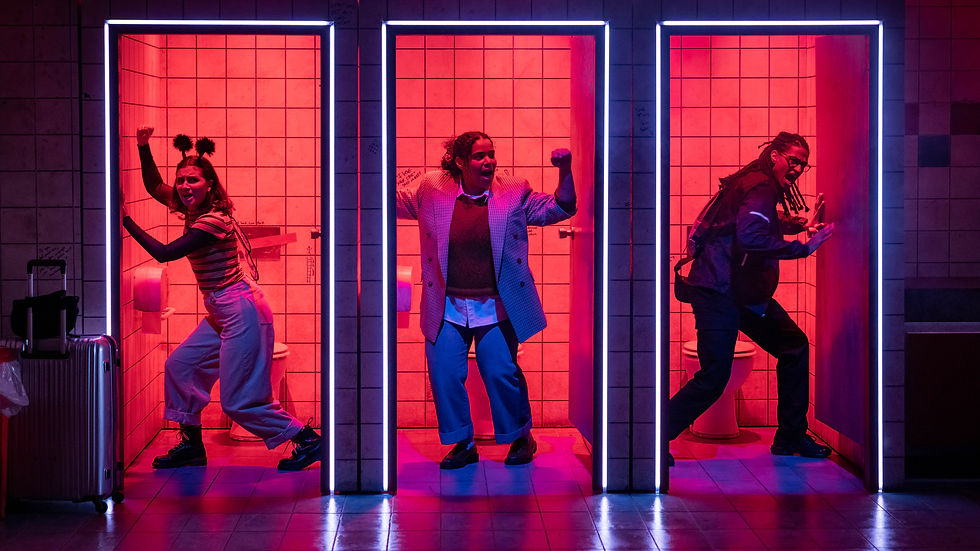
The strongest character journey belongs to Laura, played with bubbly energy by Cole Dennis. Laura begins as the sort of person who spends so much time making everyone else happy that they have forgotten how to advocate for themselves. Dennis makes that people-pleasing instinct feel genuine rather than irritating, which is why Laura's eventual awakening lands so effectively. The standout number, ‘Emma Louise’, framed around a voice note to their unfaithful fiancée, finally gives the character the redemption the story has been building towards. Dennis sells every moment of it. Watching Laura discover that self-respect is not selfishness becomes an incredibly satisfying payoff.
Matt Corner and Ivano Turco face more difficult tasks because their characters never quite escape the stereotypes established in the opening scenes. Andrew is introduced as exactly the sort of self-important city banker the audience expects him to be, right down to the expensive bicycle and work obsession. Corner works hard to uncover some humanity beneath that surface, particularly during ‘Missing Pieces’, where Andrew reflects on a failed marriage and a life he no longer recognises. The problem is that these revelations arrive so late that they never meaningfully reshape the character, but excuse his awful behaviours.

Turco's Finlay encounters a similar issue. His performance is excellent; anxious energy radiates from every line and movement, and ‘Nervous Disposition’ is delivered with impressive vocals. Yet the song arrives after the audience already understands everything it is trying to tell us. Finlay's anxiety has been explained, demonstrated and discussed long before he sings about it. The material keeps returning to points already covered.
That tendency becomes the production's greatest weakness. PUBLIC is at its best when people simply talk to one another. The conversation between Andrew and Laura about what it means to be non-binary is genuinely fascinating because it feels like two adults trying to understand each other rather than two opposing viewpoints delivering prepared speeches. Those scenes have curiosity, warmth and honesty. Elsewhere, the writing becomes so determined to hammer home its social observations that it starts to repeat its points quite bluntly. The script often explains ideas that the performances and songs have already communicated perfectly well.
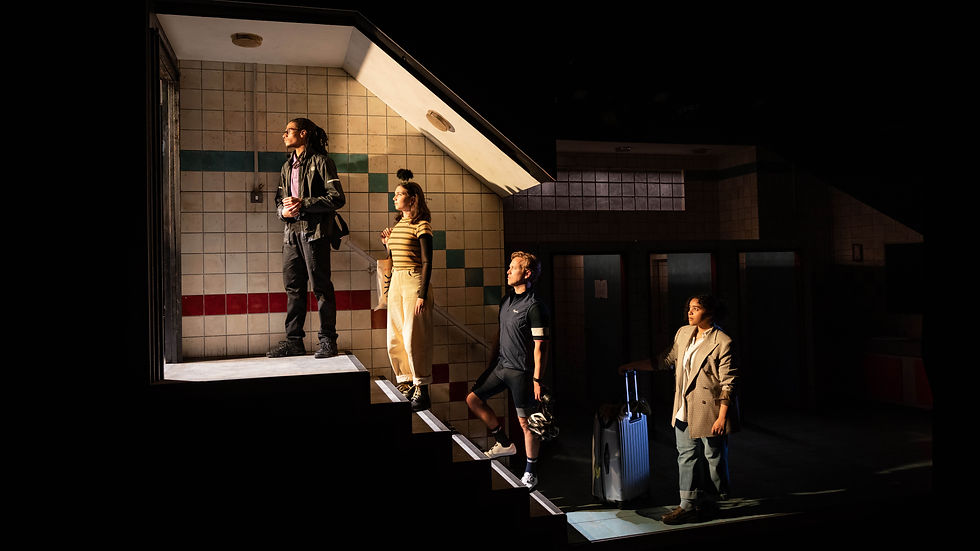
Grace Towning is great fun as Zo, a twenty-six-year-old activist whose entire personality seems built around correcting everyone around her. Towning avoids making Zo too likeable. She is entitled, self-righteous and frequently exhausting, which makes her constant declarations of allyship and pronoun policing feel more performative than progressive. The choice generates some of the show's biggest laughs.
There are some narrative threads that are introduced with care and then abandoned. Andrew's stolen bike, Zo's influencer videos, Finlay's grandmother's medication and his looming sacking from work all feel like setups waiting for meaningful payoffs. They never arrive. Character growth is discussed like a therapy session more than it is demonstrated. Zo deciding not to post her videos, Andrew reassessing his priorities, or Finlay making a phone call to his workplace could have provided an ending that shows these people have changed through this experience.
Even so, there is an undeniable charm to the musical's pop-rock score. The songs are catchy, energetic and character-driven. I will never forget the line "Tom has a perfect penis" from ‘Graffiti’, and I particularly enjoyed the inclusion of Chekhov's biodegradable confetti cannon. The score keeps the ninety-minute running time moving at a pace, although a stronger use of recurring musical motifs and reprises might have helped some of the songs linger longer in the memory.
PUBLIC may not dig as deeply as it believes it does, but it is entertaining, frequently funny and anchored by a heartfelt central message. When it stops explaining people and lets them be people, it becomes something rather special. Curve's Studio Theatre proves the perfect home for this intimate Fringe transfer, and despite a few unresolved frustrations, there is plenty here worth spending time with. Sometimes the best conversations happen in the unlikeliest places, and PUBLIC is well worth getting caught short for.


PUBLIC the Musical at Curve Leicester I need to see this. As a PhD student who works part-time at Last-Minute Assignments, I missed so many shows during college, buried in books. I was so burned out that I'd search for assignment editing service just to have energy for a night out. Your review is glowing. Thank you for that. Theatre feeds the soul. Grateful for your recommendation. Now I'm booking tickets. Keep reviewing the arts. Seriously, you're keeping culture alive for tired students like me. My inner artist thanks you. Cheers.