
Anybody For Murder - Theatre Royal Review

★★★★☆
If you like your murder mysteries with a generous helping of chaos, camp and physical comedy, Anybody for Murder is an entertaining place to start. Tabs Productions’ latest Classic Thriller Season opener gradually finds its rhythm, bringing Brian Clemens and Dennis Spooner’s comic thriller to life with a cast clearly having fun with its increasingly ridiculous plot.
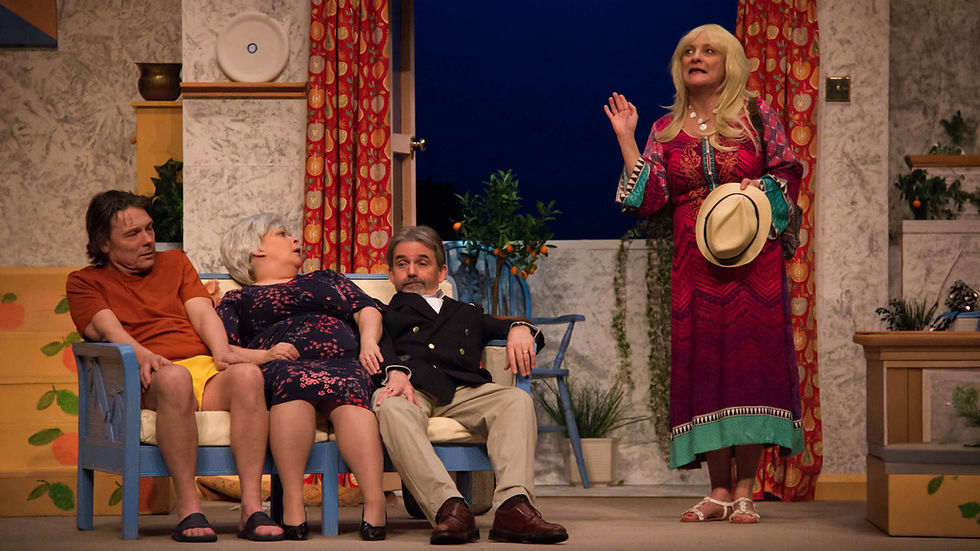
Set on a remote Greek island, the play follows Max Harrington, who plans to murder his wife Janet and collect her life insurance before running away with his girlfriend, Suzy. His carefully arranged scheme is complicated when Mary and George Ticklewell arrive with news of a huge inheritance. Suddenly, Janet is worth considerably more alive than dead, and everyone begins plotting to eliminate everyone else. Complicating matters further is neighbour Edgar Chambers, a crime writer whose knowledge of murder adds another layer of chaos to an already tangled situation.
It takes a little while for Anybody for Murder to find its pulse. Then the first laughs arrive, and something noticeably shifts in the atmosphere. The cast relaxes, the pace gains momentum, and the evening starts to feel like the kind of theatrical mischief that makes Tabs Productions’ long-running repertory work such a treat. Tabs’ 2026 season continues the company’s established Nottingham residency with three plays across three weeks, and this opening production feels particularly designed to welcome its audience into the season rather than frighten the life out of them.
The strongest comedy comes when the production lets the actors play. When George Ticklewell pushed an assumed dead Suzy Stevens to the ground, the whole audience burst into an ugly guffaw. There is an infectious sense that the cast is enjoying the ridiculousness of the situation as much as the audience.

John Goodrum’s Max is particularly entertaining because of the character’s almost cheerful relationship with murder. There is remarkably little remorse in his plotting, and Goodrum leans into that eccentricity until Max’s nonchalant attitude becomes a recurring comic device. He barely leaves the stage, carrying much of the evening’s plot while maintaining the high energy needed for farce. It is a deliberately odd characterisation, but once the production settles, it becomes one of its pleasures.
Susan Earnshaw gives Mary Ticklewell the clearest comic identity of the evening. Her performance has the imperious, socially superior quality, like a murderous Hyacinth Bucket, with Mary treating the inheritance as though everyone else is merely an inconvenience standing between her and her money. Her chemistry with David Gilbrook is wonderful. Gilbrook’s George is a wonderfully constructed simpleton: henpecked, easily manipulated and seemingly desperate to keep up with whatever his wife has decided five seconds earlier.
Jeremy Lloyd Thomas also manages to make Edgar Chambers engaging despite the character’s rather curious place in the machinery of the plot. Edgar’s tangents frequently spark exposition, but Lloyd Thomas uses those interruptions to create a character who feels like part of the increasingly chaotic puzzle. Sarah Wynne Kordas and Karen Henson are similarly comfortable with the broad farcical archetypes of Suzy and Janet, although the two characters occasionally blur together. Given that Max clearly has a type, this may even be part of the joke, but it leaves the women with less distinctive identities than some other characters.

The script itself supplies plenty of twists, reversals and misdirection, although it occasionally trusts its audience too little. The repeated references to the danger of slipping on the polished floor, followed by two near-misses, point so emphatically towards what might happen that the eventual payoff lacks excitement. The dialogue can also sound unusually constructed, with lines that feel engineered or theatrically written to steer us toward the next plot development rather than to resemble natural human speech.
That problem becomes most apparent in the ending. The final twist works, but the subsequent “this is how I did it” explanation is delivered slowly enough to drain some of the momentum the production has spent the previous hour building. A sharper, punchier reveal would send the audience out on the high created by the final reversal. Instead, the evening takes a few unnecessary laps around the crime scene.
Anybody for Murder is a light-hearted, farcical comedy about people trying to murder one another. Is it a thriller? Not particularly. Is it an extremely enjoyable way to open the Classic Thriller Season? Absolutely. With a little more pace and confidence at the beginning, and a little more bite at the end, this could become a terrific piece of theatrical murder mayhem. If you fancy a murder mystery where the bodies are secondary to the farce, Anybody for Murder is a great way to kill an evening.


Comments