
As You Like It, RSC, Review

★★★★☆
Daniel Evans’s As You Like It at the Royal Shakespeare Theatre is funny, accessible and propelled by an exceptionally watchable company, with Jonathan Groff and Fisayo Akinade at its centre. The production trusts the comedy, lets the actors find humour inside the situations rather than signalling every joke, and moves through a tangled play with clarity. But one thing that kept niggling at me throughout the production is that it has plenty of ideas about gender, music, and the division between court and forest, but they do not always seem to belong to the same play.

Shakespeare’s comedy follows Rosalind, banished from court by her uncle Duke Frederick, as she escapes with her cousin Celia into the Forest of Arden. Disguised as a young man called Ganymede, Rosalind encounters Orlando, the man she loves, and offers to “cure” him by teaching him how to woo her imaginary version of Rosalind. Around them, exiled nobles, shepherds, fools and increasingly tangled romances collide until Arden becomes a testing ground for love and identity.
Much of the verse lands with the rhythm of ordinary thought, which is important in a production likely to attract people because Jonathan Groff is the star casting. Groff’s thought-to-speech connection is excellent: an idea seems to arrive, pass across his face and leave his mouth without the gears of verse-speaking grinding underneath it. He is immensely watchable, but so is Fisayo Akinade. His Celia has immaculate comic timing and an almost protective loyalty to Rosalind; together, the friendship feels lived-in rather than mechanically required by the plot. I regularly found myself waiting for them to return.
The all-male casting is more complicated. This is a traditional single-sex staging rather than a wholesale queering. Men play the female characters as women, before Rosalind becomes a woman played by a man playing a man. Groff makes the shift into Ganymede physically clear, but the layers occasionally work against the text. “Do you not know I am a woman? When I think, I must speak” acquires a strange weight when delivered by a male actor. The final transition troubled me more. With short hair and a trousered costume, Rosalind still reads very masculine at precisely the point the plot asks us to understand that disguise as resolved. Perhaps the ambiguity is deliberate, but the staging never gave me enough to know what I was meant to do with it.

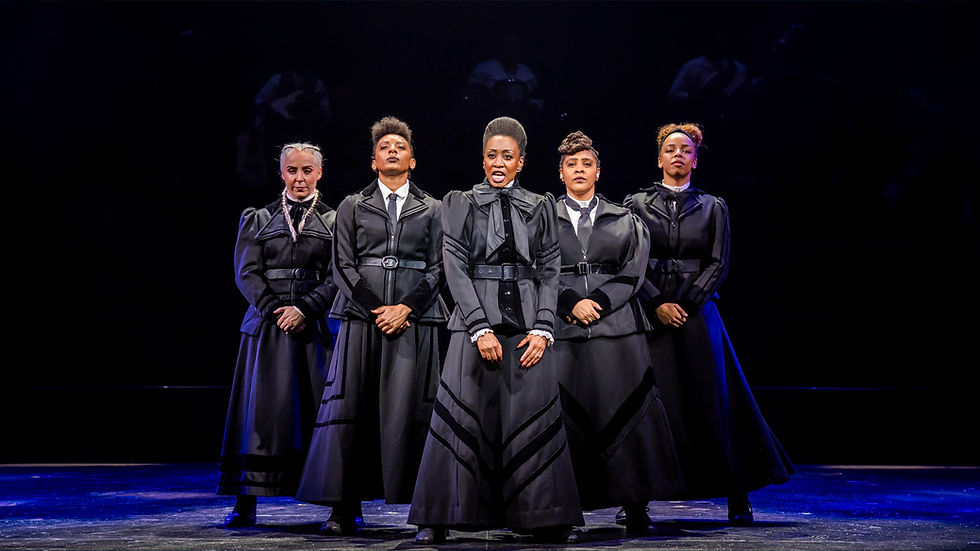
Anisha Fields’s monochrome court is cold and joyless, a world where power has bleached out almost everything human. Arden arrives as an earthy, grassy landscape with more playful costumes and a completely different texture. Each world works beautifully on its own; together, they feel more like separate concepts than two halves of one society. On press night, a set malfunction interrupted that transition and the performance had an hour-long show-stop. I would not mark the production down for that, but after sixty minutes the momentum and energy in the room had shifted.
Elliot Barnes-Worrell gives Orlando a grounded, straight-play quality that makes him feel as though he has wandered in from a more traditional As You Like It, and that is exactly why he works against the surrounding eccentricity. Greg Haiste’s Touchstone is refreshingly subdued, stripping away much of the obvious jester business, while Richard McCabe’s Jaques finds wit and melancholy without turning “All the world’s a stage” into a museum exhibit.
Gary Wilmot draws a clean distinction between the threatening Duke Frederick and the much warmer Duke Senior, while Tim Preston’s Phoebe and Edward Judge’s Silvius make another of Shakespeare’s increasingly ridiculous love triangles genuinely funny. The company understands that As You Like It works best when Arden starts filling with people pursuing entirely incompatible versions of love, and the ensemble keeps those intersecting plots from becoming narrative admin.

The Welsh choral writing helps give Arden its own identity. The ensemble creates rich a cappella harmonies that can feel almost synthesised, making Shakespeare’s frequent references to song dramatically useful rather than decorative. There is also, perhaps inevitably, the faintest ghost of Glee whenever Groff is surrounded by pristine vocal harmony. Less successful is Gareth Snook’s Audrey launching into RAYE’s ‘Where The Hell Is My Husband’. The gag gets a reaction, but paired with Audrey’s almost pantomime-dame styling, it pushes the production towards crowd-pleasing camp when the wider staging has been more disciplined.
This is an extremely enjoyable As You Like It, and one of the clearest Shakespeare productions I have seen in some time. Its best moments are Groff thinking at speed, Akinade reacting even faster, Barnes-Worrell grounding the romance and an ensemble making the language feel alive. The ideas surrounding them are sometimes less certain about how they fit together. It’s a hugely likeable trip into Arden, even if I occasionally wondered which path the production thought it was taking.



Comments