
Sylvia Review – Curve, Leicester

★★★★☆
Sylvia: A Musical Revolution at Curve, Leicester has enough bass, movement and theatrical invention to make Edwardian politics feel alive. Josh Cohen and DJ Walde’s score, Kate Prince’s choreography and Ben Stones’s design give the musical an identity entirely of its own, while Beverley Knight reminds everyone exactly why she won an Olivier for playing Emmeline Pankhurst. The frustration is that, beneath all that invention, the book spends so long recounting familiar suffragette history that Sylvia sometimes struggles to become the central character of Sylvia.
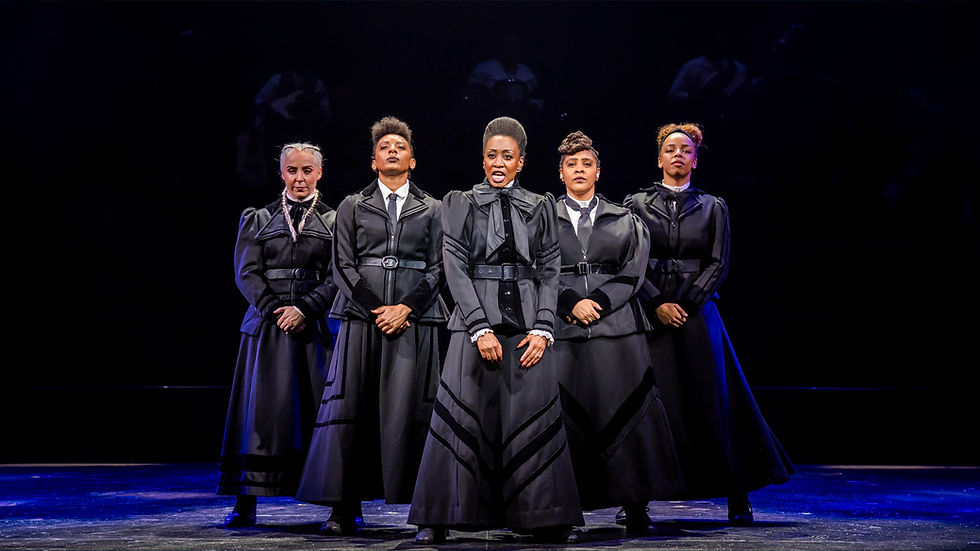
The musical follows Sylvia Pankhurst from childhood in Britain’s most famous suffragette family through the campaign for women’s votes, imprisonment, political division, and her increasingly uncomfortable relationship with the movement led by her mother, Emmeline. Along the way come Churchill, Keir Hardie, Emily Davison, hunger strikes, force-feeding, socialism, romance and several decades of British political change. Eventually Sylvia’s belief that liberation must include working-class women brings her into direct conflict with her family, and gives the musical its most interesting angle.
Musically, Cohen and Walde draw on hip-hop, funk, soul, and gospel, using musical forms associated with protest and identity rather than coating the Pankhursts in Edwardian pastiche. “First Steps of a Revolution”, “March Women March” and “Be the Change” are terrific songs, helped enormously by Caleb Wilson’s bass lines, which often feel like the engine underneath the entire production. When this score plants its feet, it absolutely knows what it is.
The production continually finds ways to bring history to life beyond the textbook. Ben Stones’s design echoes the broad brush strokes of Sylvia’s artwork, while monochrome costumes and scenery are gradually invaded by flashes of red. Watching that colour spread through Sylvia’s world as Labour politics and socialism reshape her identity is one of the evening’s smartest pieces of storytelling. Contemporary projections, lighting and Kate Prince’s drilled, fluid choreography give the suffragettes a physical language too.

The problem is that the musical rarely gives its songs enough space to be the show stoppers they actually are! Sylvia is entirely sung through (or poetically delivered), and too many songs just dump exposition or character biography. Spoken dialogue could have created valuable contrast, letting the best songs land with more weight, as many of the connecting songs feel like a conveyor belt of information. At almost two hours and fifty minutes, you feel every historical footnote squeezed into this story.
Act One races through the Pankhursts, the WSPU, and the mechanics of the campaign, but occasionally reduces the movement to variations on shouting “votes for women,” getting arrested, and attracting press attention. Fascinating lesser-known propaganda, protest methods, and the machinery of political resistance remain largely untouched. Harry Pankhurst’s death, for example, should create a major emotional rupture; instead it lands as another biographical fact before moving on. Uzuazo O’David is so funny and watchable as Harry that you miss him when he disappears, but the story gives you surprisingly little reason to grieve him.
The musical becomes far more interesting when Emmeline banishes Sylvia from the movement. This is where Sylvia’s socialism, relationship with Silvio, work with working people, and increasingly distinctive politics should take over. Instead, years begin climbing across the projection screen while the ensemble hurtles through what feels like the theatrical equivalent of a very stylish bullet-point list. Familiar history dominates the interesting story. The working class become something the musical discusses, when it should be dramatising it.
Can we just talk about Beverley Knight. Chef's Kiss. Her Emmeline is effortlessly commanding, vocally enormous and completely believable as both political leader and formidable mother. Knight won the Olivier for this performance in the 2023 Old Vic production, and it is very easy to understand why. More importantly, she gives the musical its central dramatic conflict: Sylvia eventually has to decide whether fighting alongside her mother means fighting for the same people. If nothing else, audiences should flock to this production to see Beverley Knight give what feels like a career-defining performance.

Naomi Katiyo proves excellent casting opposite her. Sylvia is an exhausting role, yet Katiyo brings a compassion that sets her apart from the more forceful characters around her. Her vocals are superb, and her articulation through the dense rap sections keeps the politics intelligible. Collette Guitart also makes a striking impression as Clementine; her voice is like liquid gold.
There were a handful of microphone problems and costume mishaps on press night, but the cast sailed through them without fuss, useful proof that when your stage already contains rap, choreography, projections and enough political activity to terrify a police officer, there is plenty available to distract the eye.
Sylvia is undeniably entertaining theatre; it is an ambitious, musically distinctive, and frequently exhilarating piece with a book trying desperately to tell us everything. Its best material begins precisely where its most familiar history ends. With tighter storytelling and more room for Sylvia’s later politics, this could be a remarkable musical. As it stands, the revolution sounds fantastic; it simply takes too long to discover whose revolution it really is.


Comments