
The Spy Who Came In From The Cold, UK Tour, Nottingham Theatre Royal Review.

★★★★☆
The Spy Who Came In From The Cold at Nottingham Theatre Royal brings John Le Carré's Cold War classic to the stage in a production packed with paranoia, moral ambiguity and noir atmosphere. But, how do you transform one of the most psychologically intricate spy novels ever into a two-hour stage thriller without losing the complex qualities that made it great in the first place?
Watch The Spy Who Came In From The Cold Rapid Review Video:
The story: Alec Leamas is a veteran British intelligence officer whose final mission appears straightforward. After a botched operation in Berlin, he is sent into apparent disgrace and gradually drawn into a complex plan designed to undermine a powerful East German intelligence figure, Mundt. As Leamas becomes increasingly entangled in layers of deception, his relationship with idealistic librarian Liz Gold places something human at the centre of a world built on lies.
What immediately strikes you about this production is the atmosphere. Many adaptations of spy fiction become obsessed with mechanics: secret files, coded messages and elaborate twists. Director Jeremy Herrin understands that Le Carré's novel focuses on a much darker place. This is a world where nobody trusts anybody, where institutions consume people without hesitation, and where certainty becomes impossible.
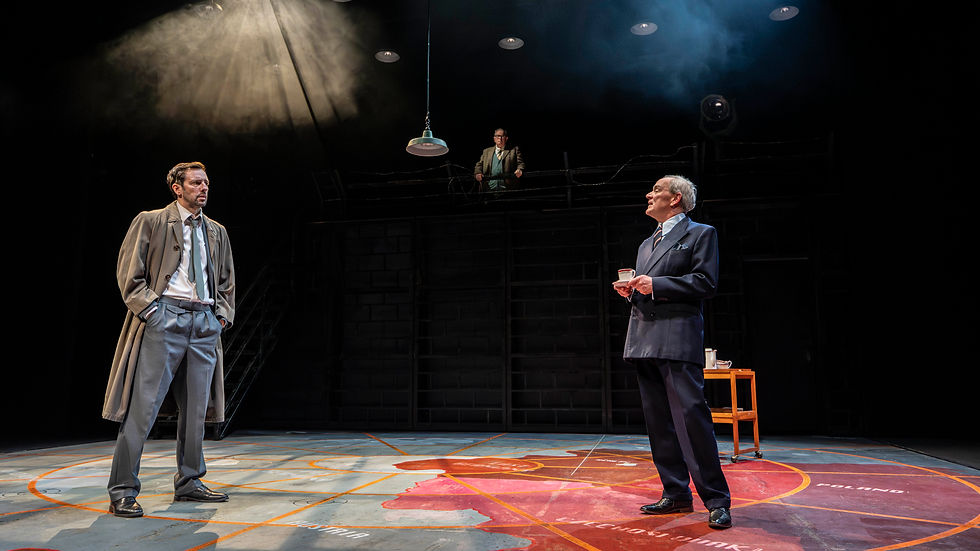
Max Jones' design does a huge amount of heavy lifting in establishing that world. Dominating the rear of the stage is a looming section of the Berlin Wall, a constant visual reminder of a divided Europe and the ideological machinery grinding away behind every conversation. For anyone familiar with Cold War history, its presence carries enormous weight before a word is spoken. It serves as both a location and a metaphor, reinforcing the barriers, secrets, and betrayals that define the story.

The production's strongest storytelling tool, however, may be its soundscape. Elizabeth Purnell's sound design and Paul Englishby's score create an atmosphere of mounting unease that often provides more emotional driving than the dialogue. The gradually increasing volume of a spinning bicycle wheel becomes oddly unsettling, while muted trumpet motifs punctuate intense moments in scenes. Englishby's jazz-infused compositions create the style of classic noir cinema without feeling too pointed. The whole production has a clear aesthetic that it nails.
Azusa Ono's lighting design shows similar design intelligence. Much of the production uses stark, single-colour washes that keep the storytelling clean and focused. However, when Leamas drifts into memory, reflection, or psychological uncertainty, the visual language changes with it. Characters emerge in a 'cold' blue light, creating a clear distinction between present reality and fragmented memory. The effect is elegant and immediately readable. In a play dense with information, these visual signposts become invaluable.
At the centre sits Ralf Little's restrained performance as Alec Leamas. Little avoids the temptation to play him as a glamorous James Bond-esque spy hero. He presents a man worn down by years of compromise, carrying the accumulated exhaustion of someone who has spent too long living in moral grey areas. There is a weariness in his posture and delivery that feels deeply earned. Little also finds moments of humour; small flashes of charm and dry wit puncture the bleakness at the right moments. The performance continually suggests a man withholding information, not only from those around him but from himself.
Gráinne Dromgoole's Liz Gold provides the production's heart. In a world dominated by manipulation and strategic calculation, Liz's sincerity becomes essential. Dromgoole never reduces her to innocence. Her political convictions, openness and faith in people make her compelling, because those qualities leave her exposed. Every scene between Liz and Leamas carries emotional stakes; there is an understated but clear connection between the actors. More than that, though, Dromgoole ensures we understand exactly what stands to be lost.
Strong support comes from Eddie Toll's Fiedler and Peter Losasso's quietly menacing Mundt. Toll brings intelligence and humanity to a role that could easily become functional exposition, while Losasso understands that true menace rarely needs volume. His calm authority proves far more unsettling than outright aggression.
The production's biggest weakness stems from the same quality that makes it admirable. Eldridge has performed remarkable script-surgery on a big and intricate novel, managing to preserve most of John Le Carré’s narrative beats while keeping events moving at considerable speed. Unfortunately, that efficiency occasionally works against the audience.

Information arrives in dense clusters. Just as one revelation begins to settle, another arrives demanding attention. Those unfamiliar with Cold War history or Le Carré's writing style may find themselves scrambling to keep up. The adaptation is at its strongest when uncertainty functions as atmosphere. It becomes less successful when the rapid delivery of the plot drifts into confusion. The final explanatory conversation between Leamas and Liz feels surprisingly blunt. After a production that largely trusts its audience to assemble the puzzle themselves, this climactic exchange lands with an unexpected neatness. It resembles the tidy drawing-room explanations of a Poirot mystery more than the morally murky world the production has spent two hours constructing.
Le Carré's novel was never going to fit neatly onto a stage. Herrin, Eldridge and their creative team understand that complete fidelity is impossible. Instead, they capture something arguably more important: the coldness, paranoia and tragic humanity at the heart of the story.
I am not usually drawn towards psychological thrillers or Cold War dramas, yet this production held my attention throughout. If this genre is already your go-to theatre style, you'll likely devour every twist and betrayal. If it isn't, the craftsmanship on display offers more than enough reason to make the journey.
Some spies come in from the cold. This one leaves you sitting in it.
(Or at least you’d hope it would in this heat wave!)


Comments