
Operation Mincemeat - Nottingham Theatre Royal Review

★★★★★
Operation Mincemeat, playing this week at Nottingham Royal Concert Hall, has all the precision of a military mission, proving that this remarkable touring production has lost none of its explosive charm. Its greatest strength lies in the astonishing five-person ensemble and whip-smart storytelling. But how does a musical built around one of history's most absurd wartime plans continue to feel this inventive every single time?
Watch The Operation Mincemeat Rapid Review:
Set during the Second World War, the story follows eccentric intelligence officer Charles Cholmondeley and the quietly assured Ewen Montagu as they develop an extraordinary deception: planting fake invasion plans on a corpse in the hope that Nazi Germany will believe the Allies intend to invade Sardinia rather than Sicily. Around that remarkable true story spins a whirlwind of MI5 bureaucracy, political manoeuvring and theatrical imagination, all brought to life by just five performers playing dozens of roles.
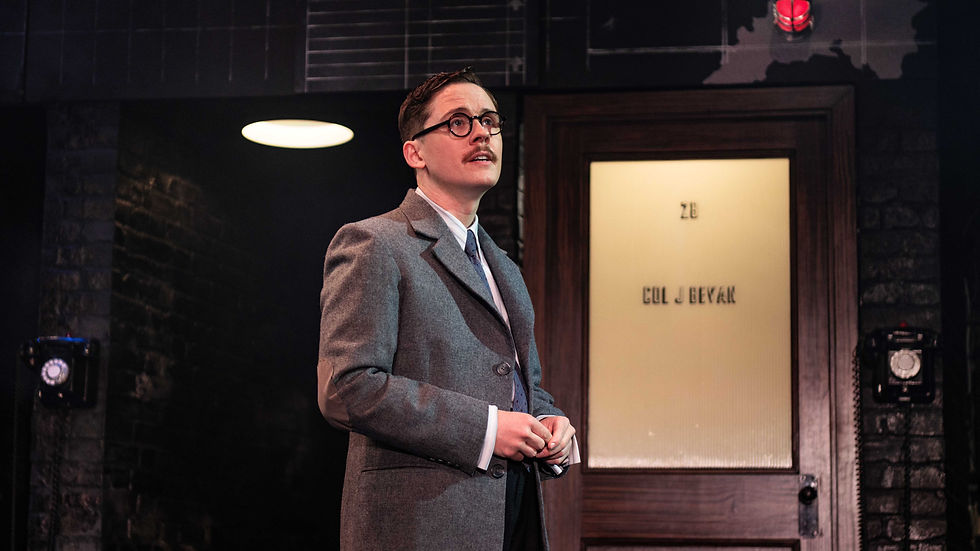
What continues to distinguish Operation Mincemeat from so many contemporary musicals (other than it not being based on a 90’s film) is its complete confidence in theatre itself. Robert Hastie's production never attempts cinematic realism because it doesn't need to. Ben Stones' elegantly economical design embraces theatrical artifice with infectious delight, inviting audiences to become willing accomplices in every transformation. A pair of spectacles on a chain instantly creates Hester Leggatt. A beanie hat suddenly turns the company into naval officers. A loud American flag on a jacket becomes the visual punchline announcing another character switch. Rather than disguising the mechanics, the production celebrates them, and every lightning-fast costume change becomes part of the comedy.

That apparent chaos only works because the company performs it with discipline. The evening feels gloriously unhinged, yet every entrance, exit, physical gesture and line lands with machine-like precision. The laughter builds through escalation rather than a string of punchlines. It is constantly running at full throttle, powered by writing and performers who trust both one another and the audience to keep up.
Seán Carey captures Charles Cholmondeley's awkward brilliance beautifully. His performance finds the right balance between exaggerated eccentricity and hesitation; the audience laughs at his quiet discomfort and understated timing, and if not, they laugh at his knowledge of a newt’s reproductive system! As the unlikely architect of Operation Mincemeat, his social unease gradually gives way to quiet determination, allowing the character to have genuine development and not just be the butt of the joke.
Charlotte Hanna-Williams, Jamie-Rose Monk and Katy Ellis each slot seamlessly into the production's relentless theatrical engine, switching effortlessly between genders, accents, ranks and personalities while maintaining remarkable vocal precision. Their character work is so sharply defined that even the smallest physical adjustment completely redraws the person standing before you. For theatre makers, if you want to see multi-role done properly, this show writes that textbook!
I forgot how much I love “Das Übermensch”; this song reminds you how cleverly structured this musical really is. Musical theatre often uses the first number after the interval as an energetic reset while audiences settle back into their seats. Here, the song does something considerably smarter. Framed as an infectiously ridiculous Nazi dance number, it immediately re-establishes the wartime setting while gleefully satirising the regime itself, calling the spirit of wartime vaudeville that used humour as a weapon against fascism. The number refreshes the audience, sharpens the production's satirical edge and restarts the momentum of the story.
When I first saw Operation Mincemeat in the West End in 2023, “Dear Bill” instantly became my favourite moment in musical theatre. That hasn’t changed. Jordan Pearson, stepping into the role of Hester Leggatt, delivers an interpretation that feels entirely his own while preserving everything that makes the song extraordinary. The performance initially leans into humour and novelty, even with Pearson approaching the letter with complete sincerity. Then the humour disappears the instant he reaches the words, "And to tell you the truth Tom," something shifts across the auditorium. Silence and stillness settle over the room in a way that so few musicals can achieve.

That emotional honesty gives the production its moral centre. After spending much of the evening delighting in bureaucratic absurdity, impossible logistics and theatrical invention, the show quietly reminds us that Glyndwr Michael was not simply the mechanism behind a remarkable military deception, but a forgotten man whose humanity deserves recognition. The transition never feels manipulative because the production has spent the entire evening carefully balancing satire directed at institutions with genuine compassion for the individuals caught within them.
There are moments where the relentless pace slightly works against textual clarity. Some of the rapid-fire lyrics disappear beneath the production's own momentum, meaning the occasional joke or clever internal rhyme slips away before it can fully register. And some of the setups to later twists come across a little heavy-handed, like constantly asking “What was his name?” or claiming “His brother is a spy!” Whilst these don’t interrupt the evening, they are moments of clunk.
There are very few productions that would have me returning to the theatre for repeat viewing, but Operation Mincemeat is very much at the top of this short list. This touring company preserves everything that made the original such a phenomenon while bringing its own personality to the mission, delivering one of the funniest, smartest and most unexpectedly moving musicals currently touring the UK. Consider this review classified. Operation Mincemeat is a mission accomplished.


Comments