
The Nightmare Room - Theatre Royal, Nottingham Review

★★★★☆
The Nightmare Room is a gripping two-hander psychological thriller with its emotional volume already turned up to 11. Sarah Wynne Kordas and Corinne Begluk bring plenty of fire to a friendship deteriorating before our eyes, piece by piece, while the production surrounds them with a beautifully stark design. But when the women are already at war from the outset, how much room is left for the tension to build?

Helen wakes up bound and blindfolded inside a locked white room, where her best friend Catherine has imprisoned her. Catherine reveals that Helen has been having an affair with her husband and presents her with a deadly proposition involving a vial of poison and a jug of water. As the confrontation develops, rapid flashbacks reveal the history of the women's friendship and the events that brought them here, while successive revelations upend the apparent rules of Catherine's game.
Following last week's comedy Anybody For Murder, Tabs Productions takes a considerably darker turn for the second week of its 2026 Classic Thriller Season. This is also the second time The Nightmare Room has appeared in the season; it was previously staged in 2018, with Kordas playing Catherine in both productions. John Goodrum's adaptation, based on a short story by Sir Arthur Conan Doyle, remains a wonderfully theatrical piece. Its rapid movement between present-day captivity and flashbacks unpicks the history between these two women, letting the audience watch their friendship sour over time rather than simply being told it has.
Those flashbacks are among the production's best moments. The tonal music and blackouts breaking up the transitions add a deliciously old-school thriller quality, while the lighting shifts from the starkness of the present to warmer, more colourful memories. Conal Walsh's forced-perspective white room completes the effect. When the lights return from a blackout and reflect across those white walls, the room seems to snap back into focus with the characters. It is a simple design concept, but one that understands exactly how to draw the audience’s attention in this character-driven story.
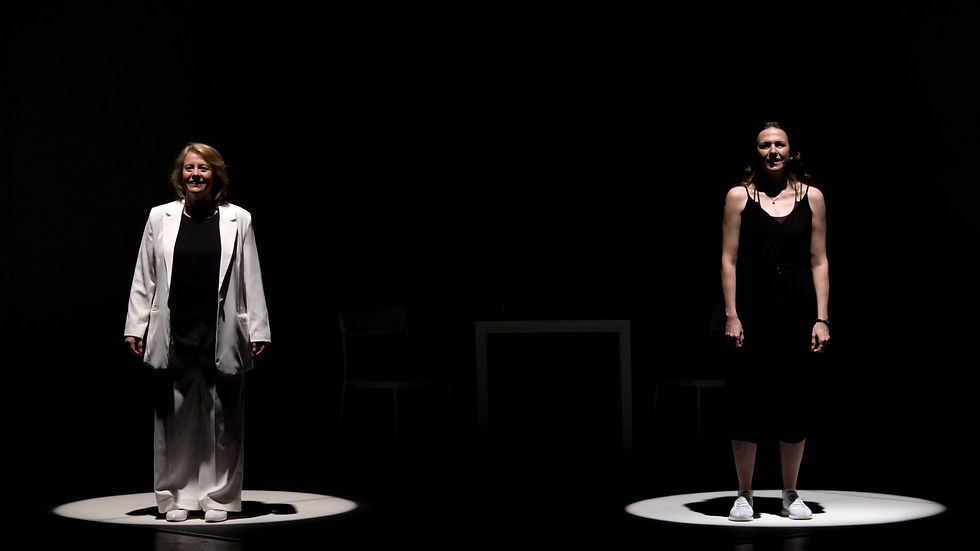
Kordas is clearly having fun with Catherine. This wealthy property developer has convinced herself that she has the perfect life, only for the discovery of her husband's affair with her best friend to send that fantasy crashing down. Kordas plays the betrayal with considerable force, making Catherine manipulative, passionate and determined to dominate the room. Kordas embraces every inch of Catherine’s theatricality in her murder plotting, ensuring this character is larger than life.
Begluk takes a similarly heightened approach to Helen, although her character has the more satisfying journey. At first she is a shaking, visibly petrified woman who appears genuinely convinced that she is about to die. As the twists accumulate, however, Begluk gradually strips away that panic and reveals a woman with considerably more control. The change from frightened captive to quietly sinister opponent is one of the production's most enjoyable developments.
The performances are also where the production occasionally loses me. Both actresses play at a heightened pitch, and while that gives the constant confrontation plenty of energy, there are moments when shouting, shaking, and frantic bartering arrive before the drama has earned them. Rather than allowing the tension to climb, these choices sometimes keep it hovering at the same level. I wanted more opportunities for Catherine and Helen to talk to each other as equals: to appeal to the friendship they once had, to bargain, to de-escalate, or even to convince themselves that this mess might still be salvaged. Those quieter negotiations would make the eventual eruptions feel genuinely explosive.

That said, this is completely understandable within the demands of repertory theatre. Tabs Productions is moving rapidly through three plays in three weeks, with The Mantrap arriving next week, so these actors have limited time to live with each character before an audience sees the finished result. This feels like a calibration issue rather than a problem with either performance or direction. As the production settles over the week, I can easily imagine those heightened choices becoming more conversational, more instinctive and ultimately more unsettling.
There is a lot to enjoy here. Goodrum's twists keep the audience guessing, Walsh's design gives the production a striking visual identity, and Kordas and Begluk bring so much personality to their characters that this poisonous friendship stays thoroughly watchable. For thriller fans, The Nightmare Room is a worthwhile second stop in Tabs Productions' 2026 season.


Comments