
Little Shop of Horrors - Derby Theatre Review

★★★★☆
Little Shop of Horrors at Derby Theatre arrives with a killer plant, a comic-book aesthetic and one hell of an impressive puppet. Sarah Brigham’s revival understands exactly why Alan Menken and Howard Ashman’s cult musical has survived for more than forty years, embracing its B-movie roots through vibrant design, inventive accessibility and a genuinely lovable central romance. But does making the show welcoming and accessible lose the dangerous edge that made the original such a deliciously dark creation?
Watch The Video Rapid-Review:
The show follows Seymour Krelborn, a shy assistant in a failing flower shop on Skid Row. His fortunes change when he discovers a mysterious plant that brings him fame, money and opportunity. There is one problem: the plant feeds on human blood. As Audrey II grows larger and more demanding, Seymour finds himself making increasingly catastrophic choices in pursuit of success and the woman he loves.
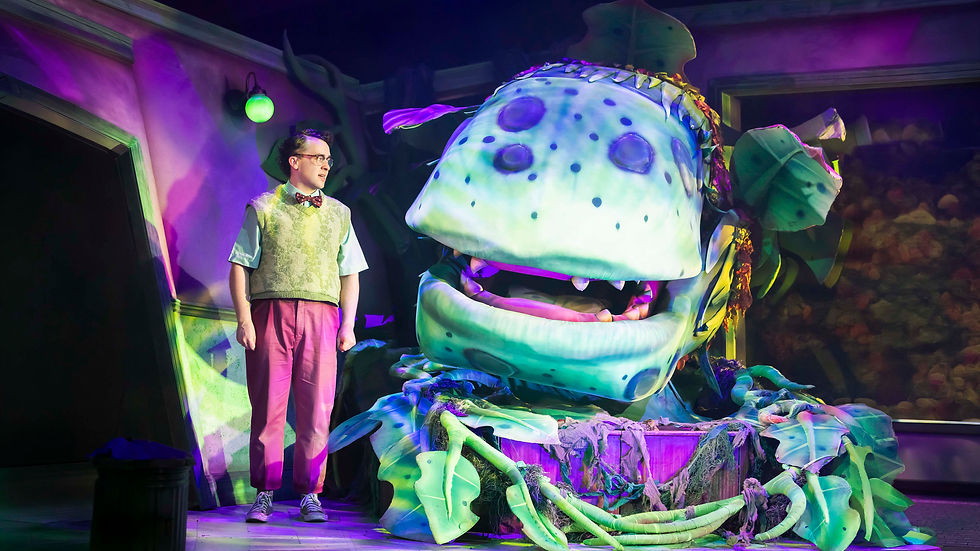
The production’s greatest achievement is Verity Quinn’s extraordinary set and costume design. Every inch of the stage feels considered, from the glowing neon architecture and comic-book geometry to the palette of pinks and greens that stretches across scenery, costumes and the plant itself. The visual world screams horror comics, pulp science fiction and B-movie cinema without becoming nostalgic pastiche. As Audrey II’s influence spreads, those colours increasingly dominate the environment, creating the impression that the plant really is infecting the world around it. The visual storytelling is amplified by KJ’s lighting design, which gradually increases the sense of danger through colour. Angry reds begin to dominate key moments of death and moral compromise.
Ben Glover’s integrated captions deserve equal praise. Many productions still treat accessibility as something that sits alongside the performance. Here, it becomes part of the artistic language. Speech bubbles, animated text and comic-book typography are projected onto the set in complete synergy with the action. The captions enhance the storytelling even for audience members who do not require them. This is a seriously smart example of creative accessibility. Other productions should be paying attention!

Then there is Audrey II, an absolutely beautiful collection of puppets. Ross Lennon’s puppetry, under John Barber’s direction, is astonishing. The mechanics disappear almost immediately, replaced by the illusion of a living, thinking creature. Audrey II reacts, stalks, tempts and threatens with remarkable precision.
Decades of iconic male interpretations have conditioned me to expect a male voice; so I was sceptical about Audrey II being voiced by Tasha Dowd. But, wow! Their performance is vocally commanding, seductive and genuinely threatening. The voice carries an enormous presence while retaining the playful manipulation that makes Audrey II so dangerous. During “Feed Me (Git It)”, paired with Kristian Cunningham’s increasingly desperate Seymour, the relationship between man and plant becomes chillingly seductive. This is the moment where the production truly sank its teeth into the audience.
Cunningham delivers what may genuinely be the finest Seymour I have seen. His Seymour is vulnerable, kind and emotionally recognisable. Surrounded by caricature-level heightened characters, he remains grounded. The sincerity of his performance made the audience fall in love with him. When Seymour begins making terrible decisions, we understand why. We may not approve, but we never stop rooting for him.
Amena El-Kindy resists imitation in her portrayal of Audrey. Rather than recreating Ellen Greene’s famous performance, she builds her own character. Her vocal power is undeniable, though I would have liked to see more of a build-up between her softer singing and her belt, as it did seem to shift from 0-100 very quickly. That said, “Suddenly, Seymour” is the production’s emotional high point. The harmonies are glorious, but what makes the number land is the sense that two damaged people are finally allowing themselves to imagine a future. For a few minutes, the entire audience believes it could happen.
The trio of Emmanuella Chede, Chioma Uma and Shekinah McFarlane provide a constant musical pulse as Ronnette, Chiffon and Crystal. Their vocals are superb, but their contribution goes beyond singing. As actor-musicians, they weave seamlessly between narration, observation and instrumental performance, helping the score feel organically connected to the action rather than existing in a separate musical world.

My reservation lies in Brigham’s softening of some of the material. Script adjustments, including changing the Dentist’s infamous “Are you dumb?” line to “Are you numb?”, are thoughtful and inclusive choices. Yet the wider approach to Orin creates problems. David Rankine plays him with broad comic energy, but the character feels closer to a pantomime villain than an abusive partner. Because he doesn’t feel genuinely threatening, Seymour's murder of him doesn’t feel wholly justifiable. The script wants us to understand the horror of what Seymour becomes in pursuit of fame. That journey loses impact when the obstacle in his path feels so cartoonishly harmless. The production prioritises warmth and audience pleasure over fully exploring the story’s nastier impulses.
That tension between camp parody and genuine darkness is also evident in the relationship between Mr Mushnik (Jon Bonner) and Seymour. The script presents Mushnik as a deeply exploitative figure: he takes in an orphan, houses him beneath the shop counter, profits from his labour, adopts him out of self-interest, and ultimately attempts to hand him over to the police when it becomes convenient. Yet many of these moments are played more like comic asides, meaning the underlying manipulation never fully lands. As a result, Mushnik's fate feels less like the culmination of Seymour's moral decline and more like a narrative necessity. The production generally balances its B-movie roots with camp-parody, but here the scales tip a little too far towards levity for a family-friendly show, softening the darker choices that give the story its bite.
Derby Theatre and Northern Stage have produced an intelligent, inventive and hugely entertaining Little Shop of Horrors. The visual storytelling is exceptional, the accessibility work is genuinely pioneering, Audrey II is a triumph, and Kristian Cunningham gives a Seymour for the ages. The darker bite may have been trimmed back, but there is still plenty here to devour. So, go and buy a ticket, but remember, don’t feed the plants!


Comments