
Midsomer Murders - UK Tour Review

★★★☆☆
The UK tour of Midsomer Murders: The Killings at Badger’s Drift arrives with significant expectations. For more than 20 years, this crime saga has lived comfortably on television, with its idyllic villages and grisly murders becoming appointment viewing for millions. The question is, does such a monumental piece of intellectual property truly translate to the stage, or should Chief Inspector Barnaby have remained safely ensconced in television’s rolling countryside?
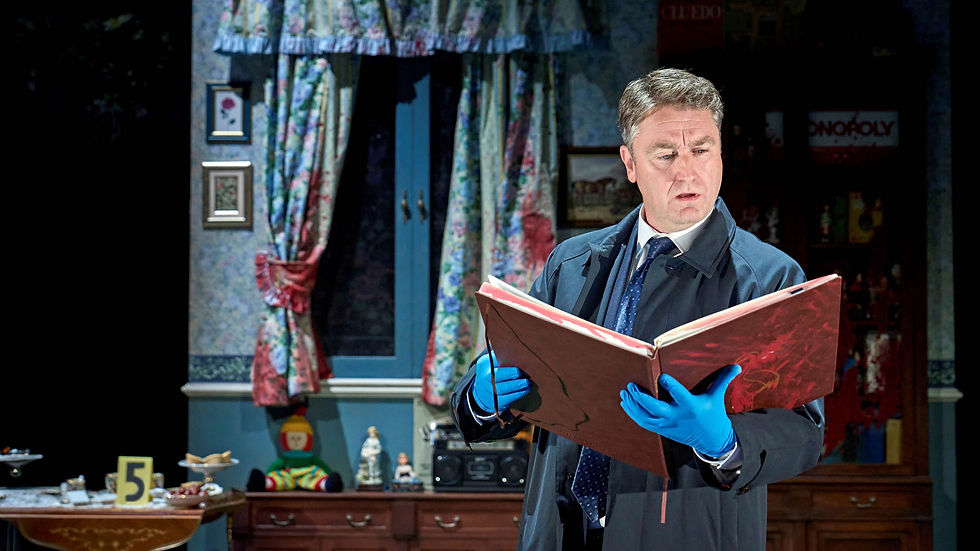
Adapted from the original novel The Killings at Badger’s Drift, the play is set in the tranquil village of Badger’s Drift, where Emily Simpson’s death appears at first to be nothing out of the ordinary. When her friend Lucy Bellringer raises concerns, Detective Chief Inspector Barnaby and Detective Sergeant Troy are dispatched to investigate, uncovering a web of secrets. As the body count rises, the gloss of village life begins to dull, revealing jealousy, greed and long-buried resentments. What unfolds is a classic whodunnit, packed with red herrings, suspicion and a grand final unmasking.
Without a doubt, the strongest element of this production is its exceptional ensemble cast. This troupe of actors navigates a sprawling narrative, multiple roles, and lightning-fast costume changes with remarkable dexterity. The sheer stamina required is impressive.
Daniel Casey steps into the shoes of DCI Barnaby with a respectful nod to the television version. Portraying such an iconic character demands balance; lean too heavily into imitation, and it becomes parody, stray too far, and you alienate loyal fans, and Casey threads that needle carefully. His Barnaby feels familiar; he carries the quiet intelligence and dry wit audiences expect, yet it feels lived-in rather than copied, finding his own rhythm within the character.
Opposite him, James Bradwell’s Sergeant Troy provides an engaging sidekick. The script oddly paints Troy as slightly dense, which doesn’t quite ring true given how often he stumbles upon key clues. Bradwell corrects this by infusing him with a professional frustration, a sense that he’d quite like someone to say “good job” once in a while. He is a likeable presence, bringing warmth and depth to the investigative partnership.

Julie Legrand is an absolute standout. As Lucy Bellringer, she delivers comedy without caricature, crafting a character brimming with eccentric charm yet grounded enough to remain believable. She commands attention with seemingly effortless timing. Later, as Phillis Cadell, she becomes an almost entirely different human being, demonstrating impressive versatility. Legrand becomes one of the production’s driving forces, ensuring that her exposition-heavy dialogue feels exciting rather than dutiful.
Chandrika Chevli’s multi-roling is equally impressive. Her brash, fur-coat-no-knickers Barbara Lessiter is a world away from her grounded, steady Dickie Whiteley, with clear physical and vocal differences between them. A particularly inventive moment sees her switch between the two mid-interrogation, using a half-and-half costume and rotating her body to transform from one character to the other in a technically slick and confidently executed sketch. However, this is where one of the production’s core issues surfaces. While the staging is undeniably clever, it tips the tone into pantomime or farce. The scene is performed with skill, but it breaks the illusion of realism, undercutting the naturalistic murder-mystery atmosphere the show was trying to build.
Because tonally, this show doesn’t know what it is. The adaptation appears torn between reverent crime drama and farcical comedy. Characters such as Iris Rainbird veer perilously close to pantomime dame territory, getting easy laughs but disrupting immersion. Similarly, Dennis is portrayed as an exaggerated absurdity, which I found actively irritating rather than engaging. The audience laughs and clearly enjoys the humour, but it undermines the tension necessary for a truly gripping whodunnit.
The production’s pacing compounds this issue. When will adaptations learn that rapid television-style scene changes simply do not work in the theatre? The play employs rapid, short scenes with frequent blackouts or transitions. On screen, quick cuts build momentum; on stage, constant scene changes interrupt rather than propel. I would campaign for fewer locations and longer scenes, which might have allowed suspense to simmer. Instead, we are ushered briskly from parlour to garden to police station before the stakes have had time to settle.

There is also a surprising amount of repetition and over-explanation. Key clues are reiterated, moments from Act One replayed in Act Two, as though the production fears its audience hasn’t been listening.
The production adds ‘theatrical flourishes’ to make the show more stage-friendly. The CSI-inspired interpretive dance is an incredibly artistic concept, but stylistically, it was confusing. I found myself thinking: Are we in a grounded detective drama? A heightened farce? Or a contemporary dance piece? The answer changes scene by scene.
Despite these structural and tonal inconsistencies, the evening works. It works because the performances are committed. It works because the design and soundscape (Ella Wahlström’s sound design cleverly echoes the television aesthetic) instantly puts the audience in familiar territory. And it works because the audience it seeks finds precisely what it wants: a comfortable, entertaining mystery delivered with flair.
This may not be a theatre designed to push boundaries or seduce the most avant-garde purists. It is unashamedly crowd-pleasing. This is theatre designed to get ITV daytime viewers into a venue, and on that level, it absolutely succeeds. The crowd were engasged, amused, and satisfied by the final reveal.
Was it my cup of tea? Not quite. Did it feel like two competing production ideas stitched together? Undeniably. But is it an energetically performed and satisfying night at the theatre that honours a beloved franchise while inviting new audiences into the building? Absolutely.
As it stands, Midsomer Murders: The Killings at Badger’s Drift is an entertaining evening, powered by a cast clearly giving it their all. If you’re a fan of the TV series, or someone new to theatre looking for a watchable, crowd-pleasing experience, this tour is well worth investigating. For me, though, it’s not quite the killer production I was hoping for.


Comments